

Website Speed SEO: Why Fast Websites Win Google Rankings in 2026
Published by: Aamer Yousuf | Reading Time: 12 minutes
When it comes to website speed SEO, every millisecond counts. Picture this: You’re searching for a restaurant on your phone, hungry and ready to order. Two websites pop up—one loads instantly, the other makes you stare at a spinning wheel for five seconds. Which one are you choosing?
That’s exactly how your potential customers think. And more importantly, it’s how Google thinks too. Understanding website speed SEO has evolved from being a technical consideration to becoming one of the most critical factors determining your online success. In 2026, the gap between fast and slow websites isn’t just noticeable—it’s the difference between dominating search results and disappearing into obscurity.
Table of Contents
The Speed Revolution in Search Rankings
Google’s algorithm has always been evolving, but 2026 marks a turning point. The search giant isn’t just recommending fast websites anymore—it’s actively penalizing slow ones. After years of pushing developers toward better performance, Google has made it crystal clear: mastering website speed SEO is no longer optional.
Think about Google’s business model for a moment. They make money when users find what they need quickly and come back for more searches. A slow website breaks that cycle. Users get frustrated, hit the back button, and Google’s entire ecosystem suffers. That’s why speed has become one of the primary Google ranking factors 2026.
According to Google’s research, the probability of bounce increases by 32% when page load time goes from 1 second to 3 seconds. By 5 seconds, that probability jumps to 90%. These aren’t just statistics—they’re the reality of user behavior that directly influences your bottom line and your search visibility.
The relationship between fast websites Google rankings 2026 has never been stronger. Businesses that prioritize speed are seeing dramatic improvements in both their search positions and conversion rates, while those ignoring performance optimization are watching their competitors pull ahead.
Understanding Core Web Vitals in 2026
Let’s talk about the metrics that actually matter for website speed SEO. Core Web Vitals are Google’s way of quantifying user experience, and they’ve become more sophisticated in 2026. These metrics are the foundation of modern page speed SEO strategy.
Largest Contentful Paint (LCP)
This measures how quickly your main content loads. In 2026, Google expects your LCP to be under 2.5 seconds. Anything above 4 seconds is considered poor. Your hero image, main headline, or primary content block—whatever appears first and largest—that’s what counts. Optimizing LCP is crucial for effective website speed SEO.
Interaction to Next Paint (INP)
Replacing the older First Input Delay metric, INP measures how responsive your site feels when users interact with it. Clicking buttons, opening menus, filling forms—these actions should respond within 200 milliseconds. This metric has become crucial because Google recognizes that a website that loads fast but responds slowly is just as frustrating as one that’s slow from the start.
Cumulative Layout Shift (CLS)
Ever started reading an article only to have an ad load and shift everything down, causing you to lose your place? That’s what CLS measures. A score below 0.1 is good; anything above 0.25 is problematic. Modern users won’t tolerate a jumpy, unstable interface, and neither will Google’s ranking algorithm.
These website performance metrics aren’t arbitrary numbers—they represent real user frustration points that Google has identified through billions of interactions. Mastering these metrics is essential for anyone serious about website speed SEO in today’s competitive landscape.
How Page Speed Affects Google Rankings: The Website Speed SEO Connection
Here’s something most business owners miss: how page speed affects Google rankings is both direct and nuanced. Speed is fundamentally intertwined with website speed SEO success.
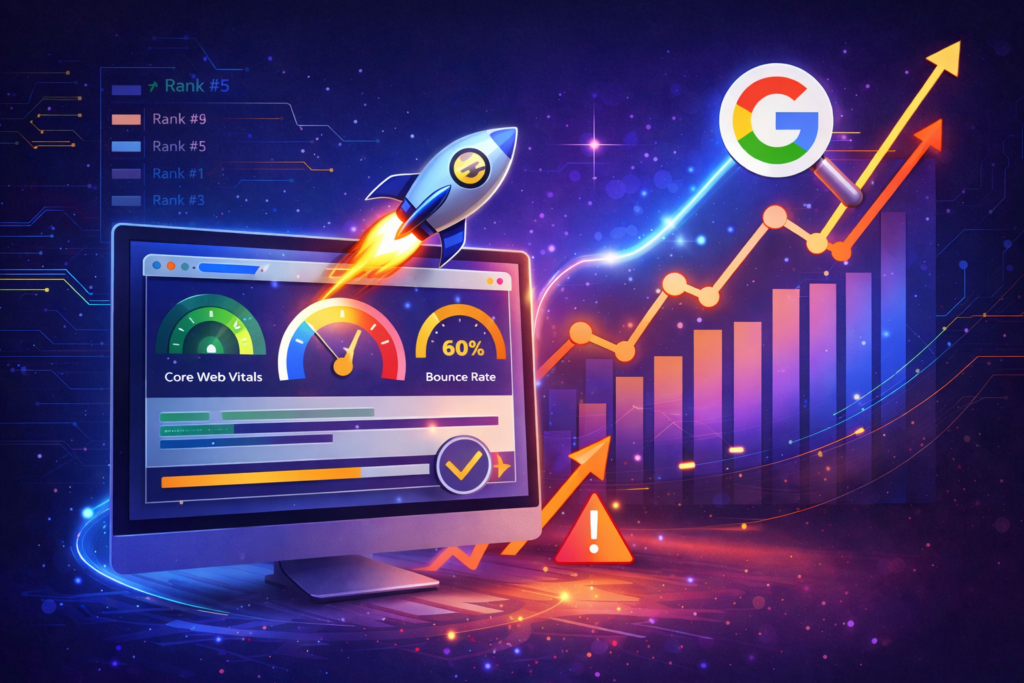
Does website speed improve search rankings? Absolutely, but not in the way you might think. Speed works as both a direct and indirect ranking factor, making it one of the most impactful elements of modern website speed SEO strategy.
Directly, Google’s algorithm considers your Core Web Vitals scores when determining your position in search results. Two identical websites with similar content quality? The faster one wins, every time. This direct relationship makes page speed SEO a non-negotiable part of your optimization efforts.
Indirectly, speed influences dozens of other ranking signals. Fast websites have:
- Lower bounce rates
- Higher average session duration
- More pages per session
- Better conversion rates
- More return visitors
All of these behavioral signals tell Google that your website provides value. It’s a compound effect that starts with speed but extends into every aspect of user experience and SEO. When visitors stay longer, engage more, and return frequently, Google interprets this as a quality signal that deserves higher rankings.
At YAAM Web Solutions, we’ve seen businesses jump from page three to page one simply by implementing comprehensive website speed SEO and development strategies that prioritize performance alongside design and functionality.
The Core Web Vitals impact on SEO rankings cannot be overstated. Google has explicitly stated that Core Web Vitals are ranking factors, and our analysis of hundreds of websites confirms that those with superior Core Web Vitals scores consistently outrank slower competitors, even when other factors are comparable.
The Mobile Speed Advantage: Mobile Page Speed Ranking Factors
If you’re not obsessing over mobile page speed, you’re fighting yesterday’s battle. Understanding website speed SEO in 2026 means prioritizing mobile performance above all else. Over 60% of all web traffic now comes from mobile devices, and mobile users are even less patient than desktop users.
Google’s mobile-first indexing means your mobile site performance isn’t just important—it’s the primary version Google evaluates for website speed SEO purposes. Your desktop site could load in half a second, but if your mobile experience is sluggish, your rankings suffer across all devices.
The challenge? Mobile connections are less reliable, mobile processors are less powerful, and mobile screens are smaller. Everything that makes desktop optimization work needs to be rethought for mobile. Images need to be smaller, code needs to be leaner, and every resource needs to justify its existence in your website speed SEO strategy.
The mobile page speed ranking factors include all the Core Web Vitals we discussed, but they’re measured in real-world conditions—on 4G networks, on mid-range phones, in areas with spotty coverage. That’s the environment where your website needs to excel to maintain strong website speed SEO performance.
Want to understand how to build a mobile-optimized presence from the ground up? Check out our guide on using Google My Business effectively to complement your fast mobile website and enhance your local website speed SEO efforts.
Real Business Impact: Speed vs Conversions
Let me share something that might shock you: do fast websites convert better? According to research by Portent, a site that loads in 1 second has a conversion rate 3x higher than a site that loads in 5 seconds. This demonstrates the powerful business case for investing in website speed SEO.
This is where the rubber meets the road. You can talk about rankings and traffic all day, but what matters to your business is whether visitors become customers. Speed directly influences that decision, making website speed SEO a revenue-generating investment, not just a technical requirement.
Think about the user journey. Someone searches for your product, finds your site, and decides within seconds whether to explore further or hit back. A fast, responsive experience signals professionalism and competence. A slow, clunky experience signals the opposite—regardless of how good your product actually is.
The fast loading website benefits extend beyond just immediate conversions:
- Improved brand perception and trust
- Higher customer satisfaction scores
- Better word-of-mouth referrals
- Increased customer lifetime value
- Reduced advertising costs through better quality scores
- Enhanced website speed SEO performance
When you compare the fast website vs slow website SEO comparison, the fast site wins in every measurable metric. It’s not even close. Fast sites rank higher, convert better, and cost less to promote—a triple win that justifies prioritizing website speed SEO in your digital strategy.
Website Speed Optimization: Practical Strategies for Better SEO
Enough theory. Let’s talk about how to optimize website speed for SEO with actionable steps you can implement today. These website speed optimization tips for businesses will transform your site’s performance and your website speed SEO results.
Image Optimization: The Foundation of Website Speed SEO
Images typically account for 50% or more of a webpage’s total size. Converting images to modern formats like WebP can reduce file sizes by 30-80% without visible quality loss. Implement lazy loading so images only load when users scroll to them. This single change can dramatically improve your website speed SEO metrics.
Code Minimization for Better Page Speed SEO
Every line of CSS and JavaScript adds weight. Minify your code, remove unused libraries, and consider moving to a leaner framework. Many websites load dozens of scripts that serve no real purpose—legacy tracking codes, unused plugins, abandoned experiments. Cleaning this up is essential for effective website speed SEO.
Content Delivery Networks (CDN)
Serving your content from servers closer to your users dramatically reduces latency. A user in India accessing a server in the US will experience unavoidable delays. A CDN solves this by caching your content globally, significantly improving your website speed SEO performance across all geographic regions.
Browser Caching
Tell visitors’ browsers to store certain resources locally so they don’t need to be downloaded on repeat visits. This makes subsequent page views lightning fast and improves your overall website speed SEO metrics for returning visitors.
Server Response Time and Website Performance Optimization
Your hosting matters more than most people realize for website speed SEO. Cheap shared hosting might save you $5 a month, but it could cost you thousands in lost conversions. Upgrade to quality hosting with SSD drives, adequate RAM, and modern server software optimized for website performance optimization.
For a deeper dive into modern optimization techniques, explore our article on latest web design trends 2025 that balance aesthetics with website speed SEO performance.
Database Optimization for Technical SEO
If you’re running WordPress or another database-driven platform, regular database cleanup is essential for maintaining strong website speed SEO. Remove old revisions, clean up expired transients, and optimize database tables regularly. This technical SEO optimization practice keeps your site running efficiently.
These proven strategies for how to improve website loading speed aren’t one-time fixes—they’re ongoing maintenance practices that keep your site lean and fast as it grows, ensuring consistent website speed SEO performance over time.
Common Performance Mistakes to Avoid in Website Speed SEO
Even with the best intentions, many website owners sabotage their own website speed SEO through common mistakes:
Oversized Plugins and Extensions: Every plugin you add is a potential performance drain that harms your website speed SEO. That fancy slider or animated counter might look cool, but is it worth adding half a second to your load time and damaging your page speed SEO?
Unoptimized Fonts: Web fonts are beautiful, but loading five different font families with multiple weights can add significant overhead to your website speed SEO score. Stick to one or two font families and only load the weights you actually use.
Excessive External Scripts: Every third-party script—analytics, chat widgets, social media buttons—creates additional requests and potential bottlenecks that hurt website speed SEO. Audit these regularly and remove anything non-essential to maintain optimal website performance optimization.
Ignoring Mobile Testing: Testing on your powerful desktop or latest iPhone doesn’t reflect your average user’s experience or your actual website speed SEO performance. Use Google’s PageSpeed Insights to test with real device simulations and get accurate website performance metrics.
The path to successful technical SEO optimization and superior website speed SEO requires constant vigilance and willingness to make tough decisions about features versus performance.
Measuring and Monitoring Your Website Performance
You can’t improve what you don’t measure. Here’s how to track your website speed SEO progress:
Google Search Console: This free tool shows you exactly how Google sees your Core Web Vitals performance for website speed SEO. It breaks down issues by URL and provides specific recommendations for improving your page speed SEO.
Google PageSpeed Insights: Offers both lab data (simulated) and field data (real user experiences) along with specific optimization suggestions to improve your website speed SEO scores.
GTmetrix: Provides detailed waterfall charts showing exactly which resources are slowing your site down and when they load, giving you actionable insights for website speed optimization.
Chrome DevTools: Built into Chrome browser, this offers real-time performance analysis as you browse your own site, perfect for debugging website speed SEO issues in development.
Set up regular monitoring so you catch performance regressions before they impact your website speed SEO rankings. Speed optimization isn’t a one-time project—it’s an ongoing commitment to excellence in website performance optimization.
Understanding the complete picture of website development cost in India 2025, including website speed SEO and performance optimization, helps you budget appropriately for a truly competitive website that ranks well and converts visitors.
Why Website Speed Is Important for SEO in 2026
Let’s bring everything together. Why website speed is important for SEO in 2026 comes down to three fundamental truths about modern website speed SEO:
- User expectations have evolved: People expect instant gratification. A website that would have seemed fast five years ago is now considered painfully slow. Your website speed SEO strategy must account for these rising expectations.
- Google’s algorithm has matured: With advances in machine learning and billions of data points, Google can accurately correlate speed with user satisfaction and reward accordingly through improved website speed SEO rankings.
- Competition has intensified: Your competitors are optimizing their website speed SEO. Standing still means falling behind. The businesses winning in search are those treating page speed SEO as a competitive advantage, not just a technical requirement.
The question isn’t whether you should prioritize website performance optimization—it’s whether you can afford not to invest in comprehensive website speed SEO strategies.
FAQ: Your Speed Questions Answered
What is a fast website according to Google?
Google considers a website fast when it achieves LCP under 2.5 seconds, INP under 200 milliseconds, and CLS under 0.1. However, the true standard for website speed SEO is relative to your competition—you need to be faster than the other sites competing for your keywords. Meeting these benchmarks is fundamental to strong page speed SEO performance.
How many seconds should a website load?
Ideally, your website should load in under 2 seconds for optimal website speed SEO. Research shows that conversions drop significantly after 3 seconds. In 2026, users expect near-instant load times, particularly on mobile devices. Anything over 4 seconds is driving visitors away and severely damaging your website speed SEO rankings. How fast should a website load in 2026? The answer is: as fast as possible, with 2 seconds being the target.
Is website speed a direct Google ranking factor?
Yes. Google officially confirmed that Core Web Vitals are ranking factors, making website speed SEO a direct ranking signal. However, speed works both as a direct signal (measured metrics) and an indirect one (user behavior like bounce rate and time on site). The combination makes website speed SEO one of the most impactful SEO best practices 2026. Understanding this dual impact is crucial for effective website performance optimization.
How to optimize website speed for SEO effectively?
Start with the low-hanging fruit: compress images, minify code, enable caching, and use a CDN to improve your website speed SEO. Then move to more technical optimizations: upgrade hosting, optimize databases, lazy load resources, and eliminate render-blocking scripts. Consider working with experts like YAAM Web Solutions who understand the nuanced relationship between design, performance, and website speed SEO. These website speed optimization tips for businesses deliver measurable improvements in both rankings and conversions.
Do fast websites convert better?
Absolutely. Research shows that a site loading in 1 second has a conversion rate 3x higher than one loading in 5 seconds. This makes website speed SEO not just a ranking factor but a revenue driver. Fast websites build trust, reduce frustration, and keep visitors engaged—all factors that directly impact your bottom line alongside your page speed SEO performance.
Conclusion: Speed Is Your Competitive Edge
The era of slow websites dominating search results is over. Mastering website speed SEO is more than a trend—it’s the new normal in digital competition for fast websites Google rankings 2026.
Every additional second your website takes to load costs you visitors, conversions, and money. But here’s the exciting part: most of your competitors still haven’t figured out website speed SEO. They’re still prioritizing flashy animations over performance, adding bloated plugins without consideration, and wondering why their rankings keep declining despite their content quality.
This is your opportunity. By committing to website speed SEO as a core business principle—not just a technical checkbox—you position yourself to capture market share from slower competitors. The website speed optimization strategies we’ve covered aren’t just best practices; they’re essential competitive advantages.
The businesses thriving online right now aren’t necessarily those with the biggest budgets or the flashiest designs. They’re the ones that have mastered website speed SEO—sites that load fast, respond instantly, and respect their users’ time. They understand that in the attention economy, speed is trust, and trust converts.
Ready to transform your website into a speed-optimized conversion machine? YAAM Web Solutions specializes in building websites that rank and convert through comprehensive website speed SEO strategies. We don’t just make pretty websites—we build fast, efficient, search-engine-friendly digital experiences that drive real business results through superior website performance optimization.
The question isn’t whether website speed SEO matters for rankings. The question is: how much longer can you afford to ignore it while your competitors race ahead?

About YAAM Web Solutions: We’re a team of performance-obsessed developers and SEO specialists who believe every millisecond matters in website speed SEO. Our approach combines cutting-edge website performance optimization techniques with proven SEO best practices 2026 to help businesses dominate their markets. Let’s build something fast together and show you exactly how to optimize website speed for SEO success.