Headless CMS Development :The Future of Modern Website Architecture 2026 Complete Guide
Headless CMS Development :The Future of Modern Website Architecture 2026 Complete Guide
Headless CMS Development:
The Future of Modern Website Architecture
Everything you need to know about headless CMS development in 2026 — platforms, performance, SEO, and why forward-thinking businesses are making the switch.
Headless CMS development is redefining how modern websites are built in 2026. If you’ve been running a website on a traditional CMS, you’ve likely hit its walls — slow page loads, rigid templates, a plugin ecosystem that feels more like duct tape than architecture. Headless CMS development is the answer the web industry has been building toward for over a decade — and in 2026, it’s no longer a niche choice. It’s the standard for businesses serious about performance, scalability, and user experience.
In this guide, we break it all down in plain terms. What headless CMS actually means. How it compares to the traditional approach. Which platforms lead the space. How developers build with it. And most importantly — why it genuinely matters for your business outcomes and search rankings.
- → Headless CMS development decouples frontend from backend, delivering content via API to any device.
- → Pages load 3.5× faster compared to traditional CMS — directly improving Core Web Vitals.
- → Top platforms in 2026: Strapi, Contentful, Sanity, Headless WordPress, Ghost CMS.
- → Next.js is the dominant frontend framework for headless CMS projects in 2026.
- → Businesses switching to headless CMS see up to 40% improvement in Core Web Vitals scores.
What is Headless CMS Development?
To understand headless CMS development, it helps to first understand what “headed” looks like. A traditional CMS — think WordPress, Joomla, or Drupal — bundles everything together. The content lives in a database, the backend manages it, and the frontend renders it via themes and templates. Convenient, but full of constraints.
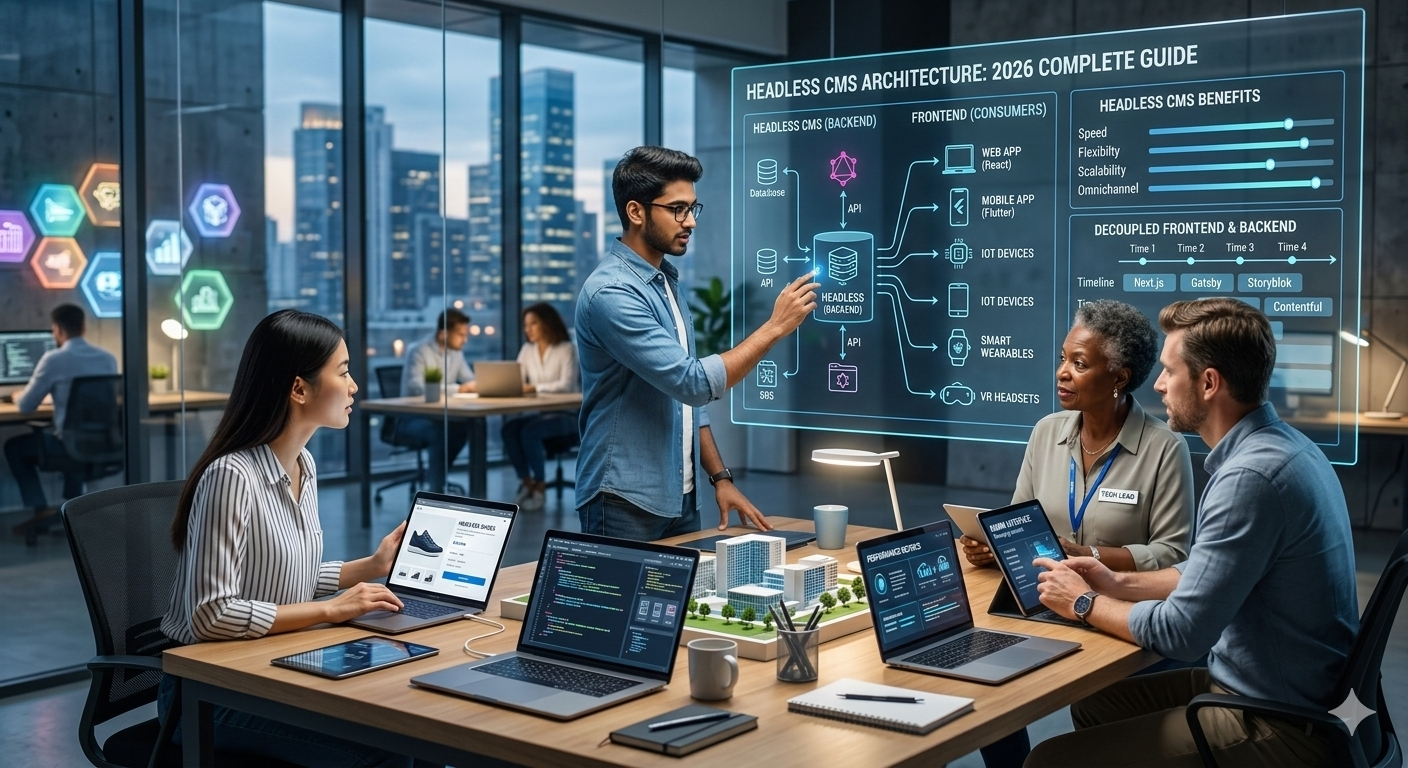
A headless CMS removes the “head” entirely. The frontend and backend are completely decoupled. Your content is stored and managed in the backend — but instead of built-in templates, the CMS exposes content through an API (REST or GraphQL). Your frontend — built in React, Next.js, Vue, or any modern framework — fetches that content and renders it however it wants.
This is the core idea behind API-first CMS development. The content doesn’t care how it’s displayed. It exists as structured data, ready to be pulled by any interface — a website, mobile app, smart TV, voice assistant, or kiosk.
The Core Architecture in Plain Terms
- Content Repository: Where editors create and manage structured content (entries, fields, assets).
- Content API: REST or GraphQL endpoints that serve content on demand to any frontend.
- Frontend Application: Built independently, consuming API data and handling all presentation.
- Deployment Layer: CDN-distributed static builds (SSG) or server-rendered apps (SSR) for maximum speed.
Headless CMS vs Traditional CMS: Key Differences
The debate between headless CMS vs traditional CMS isn’t about which is better in absolute terms — it’s about what your project needs. For any business that cares about speed, scale, and developer control, the headless approach wins on almost every dimension.
| Factor | Traditional CMS | Headless CMS |
|---|---|---|
| Architecture | Tightly coupled frontend + backend | Fully decoupled independent layers |
| Frontend Flexibility | Limited to built-in themes/templates | Complete freedom — any framework |
| Performance | Moderate server-side rendering | Excellent static/JAMstack, CDN delivery |
| Scalability | Requires server scaling; bottlenecks | Scales effortlessly via CDN edge |
| Multi-channel | Limited — one web frontend | Native — web, mobile, IoT, voice |
| SEO Capabilities | Plugin-dependent; mixed results | Full technical SEO control |
| Security | Frontend exposed; plugin risks | Isolated frontend — smaller attack surface |
| Developer UX | Constrained by CMS conventions | Full modern stack freedom |
| Best For | Simple blogs, small sites | Scaling businesses, omnichannel apps |
💡 The bottom line: Traditional CMS platforms still serve simple use cases well. But if your business is growing, serving multiple platforms, or competing on performance — headless CMS development is the architecture you need.
Why Businesses Are Switching to Headless CMS in 2026
The shift isn’t just a tech trend. It’s driven by concrete business problems that traditional CMS systems have stopped solving. Here’s what’s pushing companies to make the move.
1. Website Speed Is Now a Business Requirement
Google’s Core Web Vitals are direct ranking factors. A one-second delay in page load time can cost an e-commerce site up to 7% in conversions. Headless architectures serve pre-rendered static pages via global CDN — delivering sub-second load times that traditional CMS setups simply cannot match.
2. Your Content Needs to Reach Multiple Screens
In 2026, content doesn’t just live on a webpage. It might appear on a mobile app, connected TV, in-store kiosk, voice assistant, or third-party platform. With headless, you write content once and deliver it everywhere via API — the foundation of true omnichannel content delivery.
3. Your Development Team Shouldn’t Be Blocked
Traditional CMS platforms constrain development. Headless CMS architecture separates the content concern from the code concern — giving developers full freedom to work with modern front-end frameworks for CMS like React, Next.js, and Vue without compromise.
4. Security Improves Dramatically
With headless CMS, the backend is completely separate from the public frontend. Even if someone discovers the admin URL, it doesn’t compromise the user-facing site. Security teams consistently prefer this architecture.
5. True Scalability on Demand
Sudden traffic spikes can bring down a traditional CMS server. JAMstack and headless deployments serve pre-generated pages from a CDN — no server to overload. This is what true scalable web applications look like.
Best Headless CMS Platforms in 2026
Choosing the right platform is one of the most consequential decisions in any headless CMS project. The ecosystem has matured significantly. Here are the platforms worth serious consideration in 2026.
| Platform | Type | Best For | API | Pricing |
|---|---|---|---|---|
| Strapi | Open Source | Startups, dev teams | REST + GraphQL | Free / Cloud |
| Contentful | SaaS | Enterprise | REST + GraphQL | Free → Enterprise |
| Sanity | SaaS/Cloud | Real-time, flexible | GROQ + GraphQL | Free → Growth |
| Headless WP | Open Source | Familiar editors | REST + WPGraphQL | Free (hosting) |
| Ghost CMS | Open Source | Publishers, blogs | REST API | Free / Pro |
Not sure which platform fits your business? Our team at YAAM Web Solutions evaluates your content model, team workflow, and scaling needs before recommending a platform — so you don’t end up locked into the wrong choice.
How Developers Build Websites Using Headless CMS
Understanding the development workflow sets realistic expectations for timelines and complexity. Here’s how a typical headless CMS for websites project comes together step by step.
Content Modeling & CMS Setup
Define content types — blog posts, products, landing pages. Set up structured schemas in Strapi, Contentful, or Sanity.
API Configuration
Configure REST or GraphQL endpoints. Define permissions, auth tokens, and query structures for precise, efficient data delivery.
Frontend Development (React / Next.js / Vue)
Next.js is the dominant choice in 2026, offering both SSG and SSR — full control over performance and SEO from day one.
API Integration & Data Fetching
Connect the frontend to CMS APIs with static props at build time for marketing pages, and incremental static regeneration for dynamic content.
Preview & Staging Environment
Set up live preview so editors can review unpublished content before it goes live — essential for non-technical editorial teams.
Deployment via CDN (Vercel / Netlify / Cloudflare)
Deploy to a global CDN. Every CMS update triggers an automated build pipeline. Your site is always fast, always fresh.
For a real-world example — this guide on website migration without losing SEO walks through how architectural transitions are handled in production without dropping rankings.
SEO Benefits of Headless CMS Development
The most common question: “Will going headless hurt our SEO?” When implemented correctly, the answer is the complete opposite. Headless CMS architecture gives you more SEO control than any traditional CMS.
Faster Pages = Higher Rankings
Google’s algorithm directly weights Core Web Vitals — LCP, FID, and CLS. Static pages served from a CDN consistently achieve exceptional scores across all three. This is the single most direct SEO advantage of headless CMS development.
Full Control Over Technical SEO
With Next.js, every SEO element is programmatically controlled — title tags, meta descriptions, canonical URLs, Open Graph tags, schema markup, hreflang, and sitemap generation. No plugin dependencies. No hidden overrides.
Structured Data Made Easy
Headless systems make JSON-LD schema markup trivial at the page level. Google uses structured data to power rich snippets and featured snippet positions. In a headless setup, it’s just JavaScript — clean, predictable, and consistent.
Mobile-First Performance
Google indexes the mobile version of your site first. CDN-distributed JAMstack pages load in under a second on mobile — directly translating into better mobile rankings, one of the most competitive SEO battlegrounds in 2026.
🔍 Google Developers confirms that page experience signals — loading performance, interactivity, and visual stability — are direct ranking inputs. Headless CMS architecture is purpose-built to maximize all three. Read on Google Developers →
Common Mistakes When Implementing Headless CMS
Done right, headless CMS development is transformative. Done poorly, it creates expensive, unmaintainable systems. Here are the most common mistakes — and how to avoid them.
Future of Headless CMS & API-First Development (2026 and Beyond)
The headless CMS space is evolving rapidly. Here’s where the industry is heading and what forward-thinking businesses should be watching.
AI-Powered Content Management
CMS platforms are embedding AI directly into editorial workflows. Automatic content tagging, AI-generated metadata, smart recommendations, and automated localization are becoming standard tooling across platforms like Contentful and Sanity.
Headless Commerce Taking Over Retail
E-commerce is one of the fastest adopters of headless architecture. Brands using Shopify Hydrogen or Medusa with custom frontends build shopping experiences that convert significantly better than any standard template.
Multi-Device and Voice Interface Integration
As voice interfaces, AR apps, and connected devices proliferate, the value of a channel-agnostic content repository becomes obvious. That’s exactly what API-driven content management enables at scale.
Edge Computing and Content Delivery
Headless CMS combined with edge compute platforms (Cloudflare Workers, Vercel Edge Functions) enables personalized experiences at CDN speeds — closing the gap between static performance and dynamic personalization.
Composable Architecture Becomes Standard
The “composable DXP” concept — assembling best-of-breed tools for CMS, search, commerce, and personalization — is gaining serious enterprise traction. Headless CMS is the foundational layer that makes it possible. By 2027, Gartner predicts the majority of enterprise platforms will be composable by design.
Frequently Asked Questions About Headless CMS Development
Your Business Deserves a Faster, Smarter Website
YAAM Web Solutions helps startups and scaling businesses build fast, scalable, and future-ready websites using modern technologies like headless CMS and API-first architecture. Whether you’re starting fresh or migrating an existing platform, our team delivers the strategy, architecture expertise, and execution to make it real.
Explore Our Services →