AI-Powered Landing Pages: Boost Conversions in 2026
2026 Complete Guide
How AI-Powered Landing Pages Are Increasing Website Conversions in 2026
Everything developers, marketers, startups, and business owners need to know — from choosing the right AI builder to optimizing for conversions and outranking competitors.
16 min read
April 2, 2026
YAAM Web Solutions
✍️ Written by YAAM Web Solutions Team|🗓️ Published: April 2, 2026|🔄 Updated: April 2, 2026
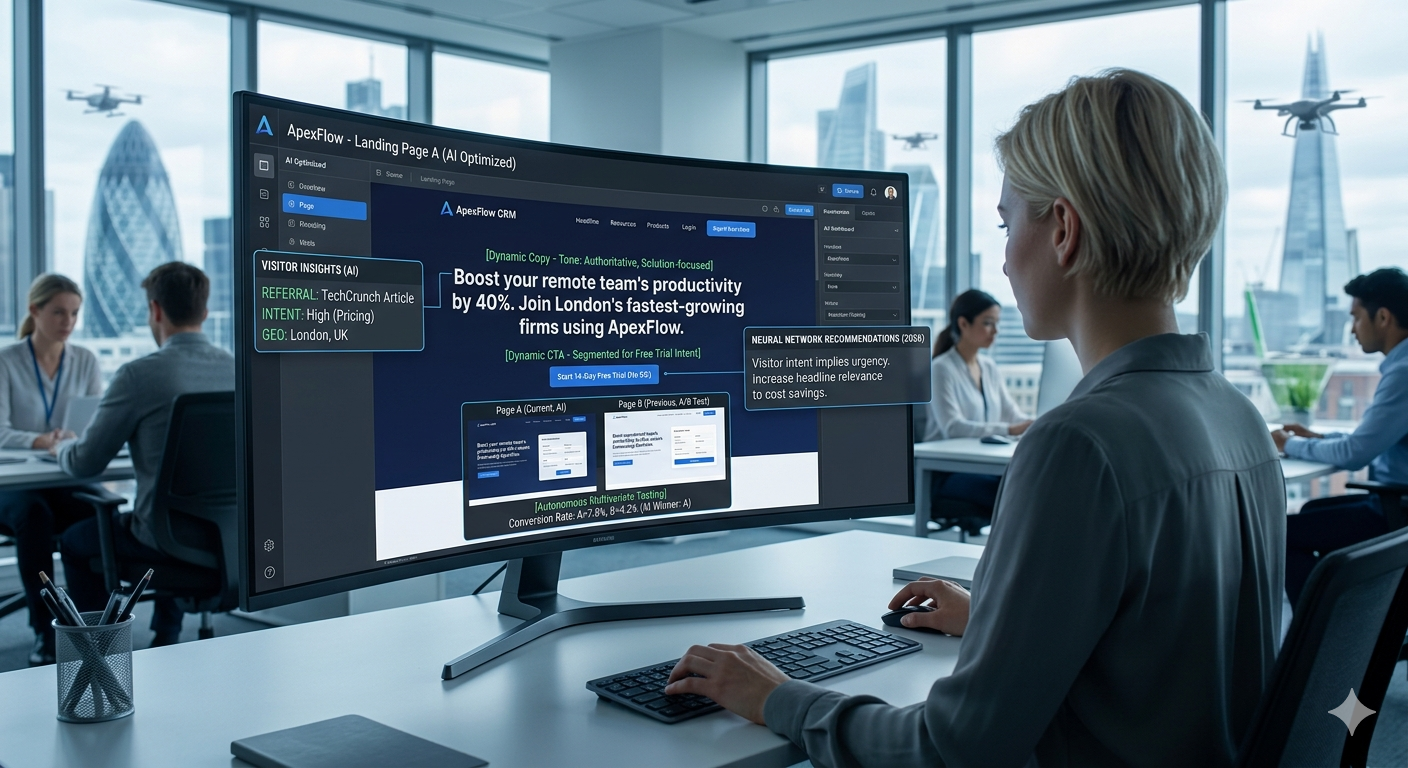
AI-powered landing pages — complete 2026 optimization and conversion guide by YAAM Web Solutions
Every visitor who lands on your website and leaves without converting is revenue walking out the door. For years, fixing that meant hours of manual A/B testing, expensive copywriters, and constant design iterations. In 2026, AI-powered landing pages have completely changed that equation. By combining machine learning, dynamic content generation, and real-time behavioral analysis, AI-powered landing pages automatically serve each visitor the version of your page most likely to convert them — without any manual intervention from your team.
At YAAM Web Solutions, we’ve built and optimized AI-powered landing pages for businesses across e-commerce, SaaS, healthcare, and professional services. The consistent finding: pages powered by AI outperform traditionally built pages by a significant margin — and they keep improving over time. This guide covers everything you need to know to leverage them for your business in 2026.
What Are AI-Powered Landing Pages?
AI-powered landing pages are web pages created, optimized, or continuously improved using artificial intelligence tools. Unlike a static page built once and left unchanged, an AI-powered landing page uses machine learning algorithms to analyze visitor behavior, adapt content in real time, and serve each user the version of the page statistically most likely to result in a conversion.
The AI component can operate at several levels simultaneously: generating the initial copy and layout from a text prompt, running automated multivariate tests across headlines and CTAs, personalizing hero images and offers based on traffic source, and adjusting the entire page flow depending on how a specific visitor segment behaves.
AI-powered landing pages process visitor signals and serve optimized content in under 50ms
How AI Tools Generate Landing Pages
Modern AI landing page builders accept a plain text prompt — your product name, target audience, and goal — and generate a complete page including headline, subheadline, feature bullets, social proof blocks, and a CTA in under 60 seconds. Platforms like Framer AI and Unbounce Smart Builder use large language models trained specifically on high-converting marketing copy, meaning the initial output isn’t generic filler — it’s persuasive, structured content that follows proven conversion frameworks.
Beyond initial generation, the AI layer continuously tests variations. A traditional marketer might run one A/B test per month. An AI system on an active AI-powered landing page tests dozens of micro-variations simultaneously, learning and redistributing traffic toward winners within hours rather than weeks.
3.8×average conversion rate lift from AI-powered landing pages vs static pages
60saverage time to generate a complete first draft with a top AI landing page builder
72%of digital marketers plan to use AI landing page optimization tools in 2026
The core reason AI-powered landing pages outperform traditional ones is that they stop serving one static page to every visitor. A visitor from a Google ad, a returning customer from email, and a cold visitor from social media all have different contexts, intent levels, and objections — yet a static page treats them identically. AI ends that one-size-fits-all failure mode.
🎯
Smart Personalization at Scale
AI reads traffic source, device type, location, past behavior, and real-time scroll patterns to assemble a page tailored to that specific visitor. A visitor from a LinkedIn ad for enterprise software sees different copy than a visitor from an Instagram ad for the same product — automatically.
🔬
Automated A/B Testing
Traditional A/B testing requires a statistician, a testing platform, weeks of traffic, and manual analysis. AI landing page builders run continuous multivariate tests across headlines, images, CTA text, layout order, and color — and self-optimize toward the winner without human involvement.
✍️
Dynamic Content Optimization
The headline a cold prospect sees is not the same headline a warm retargeting visitor sees. AI dynamically swaps content blocks based on funnel stage, removing friction for users who already know the product and providing more context for those discovering it for the first time.
📐
Behavior-Based Design Adjustments
AI heatmap analysis and scroll tracking identify exactly where users lose interest. The system automatically repositions CTAs, shortens sections, or inserts social proof at the drop-off points — without a designer touching a single pixel.
✅ Real-world result: A B2B SaaS client at YAAM Web Solutions increased their free trial signup rate by 58% within 45 days of switching from a static landing page to an AI-powered landing page with dynamic headline personalization — without changing their ad spend.
Key Features of AI Landing Page Builders
Not every tool marketed as an AI landing page builder delivers the same depth of capability. Here are the core features that separate genuinely powerful platforms from simple AI text generators dressed up as page builders.
🤖
AI Design Generation
True AI design generation goes beyond placing text into a template. Platforms like Framer AI and Webflow AI generate custom layouts, choose contrasting color schemes, set hierarchy, and create component arrangements that follow UX best practices — all from a single text prompt describing your brand and goal.
📈
Conversion Optimization Engine
The best AI landing page builders include a built-in CRO engine that applies conversion rate optimization frameworks automatically — urgency signals, trust badges, benefit-focused headlines, and friction-reducing form designs are implemented by default, not as an afterthought.
✍️
AI Copywriting
AI copywriting for landing pages draws on training data from thousands of high-converting pages. It generates benefit-led headlines, objection-handling subtext, and CTA microcopy calibrated to your specific audience — something that would take an experienced copywriter hours to produce manually.
🔥
Heatmap & Scroll Analysis
Integrated heatmap analysis shows precisely where visitors click, hesitate, and abandon. AI interprets this data and suggests — or automatically implements — layout changes that move key conversion elements into the user’s natural attention path, dramatically reducing the gap between views and actions.
📐
Smart Layout Recommendations
AI layout engines analyze your industry, traffic source, and conversion goal to recommend the optimal page structure. A lead generation page for a B2B SaaS company gets a different layout recommendation than an e-commerce product page — and both are backed by conversion data, not guesswork.
🔗
CRM and Ad Platform Integration
Leading AI landing page builders sync directly with Google Ads, Meta Ads, HubSpot, Salesforce, and other platforms. This means your AI landing page can read the ad keyword that drove the click and dynamically mirror that exact language in the page headline — a tactic called Dynamic Keyword Insertion that lifts Quality Scores and conversion rates simultaneously.
Best AI Landing Page Builders in 2026
Here’s an honest, up-to-date comparison of the best AI landing page builders currently available. Each has a different strength — matching the right tool to your use case is critical.
Top AI landing page builders for creating AI-powered landing pages in 2026
Tool
Best For
Key Features
Starting Price
Framer AI
Design-Led Teams
AI layout & copy generation, CMS, animations, custom code components
$10/mo
Unbounce Smart Builder
Marketers & CRO
AI traffic optimization, dynamic text replacement, smart copy assist
$99/mo
Wix ADI
Small Business
AI wizard setup, drag-and-drop editor, built-in SEO, free tier
Free / $17/mo
Durable AI
Speed & Simplicity
30-second page generation, AI copy, CRM, invoicing tools included
$12/mo
Webflow AI
Developers
Full code + visual editor, AI content assist, powerful CMS, SEO controls
$18/mo
Instapage AI
Ad Campaign Teams
AI personalization blocks, AdMap, 1:1 ad-to-page matching, heatmaps
$299/mo
💡 Our recommendation from YAAM Web Solutions: For most businesses starting with AI-powered landing pages in 2026, Framer AI offers the best balance of design quality, AI depth, and price. Marketers running paid ad campaigns should evaluate Unbounce Smart Builder for its Dynamic Keyword Insertion and traffic optimization engine.
How to Build an AI-Powered Landing Page (Step-by-Step)
Building your first AI-powered landing page is significantly faster than a traditional build — but the planning stage still matters. Here is the complete process from zero to a live, optimized page.
5-step process for building AI-powered landing pages that drive conversions
1
Choose Your AI Landing Page Builder
Select a platform that matches your team’s skills and campaign goals. Design-led teams benefit from Framer AI. Performance marketers should evaluate Unbounce Smart Builder for its Smart Traffic feature. Developers who need full control should consider Webflow AI. Reference the comparison table above and trial two or three tools before committing.
2
Write a Specific AI Prompt
The quality of your AI-generated page is directly proportional to the quality of your prompt. Include: your product name and one-sentence description, your target audience (job title, pain point, industry), your primary conversion goal (sign-up, purchase, call booking), your brand tone (professional, playful, authoritative), and one or two competitor names to position against. A vague prompt produces a generic page. A specific prompt produces a high-converting one.
3
Generate and Review Your Landing Page
Let the AI generate the initial draft. Review every content block with a critical eye: Is the headline benefit-focused? Does the CTA use action language? Is the value proposition above the fold? Does the social proof feel authentic? Edit the AI’s output — it is a starting point, not a final product. The AI saves you 80% of the build time; your judgment covers the remaining 20%.
4
Optimize for Conversions
Apply proven CRO principles to your AI-powered landing page: ensure the primary CTA is visible without scrolling, add 3–5 specific data points as social proof, remove navigation links that let visitors escape the page, compress images for sub-2s load time, and enable the platform’s built-in AI optimization features such as dynamic text replacement and smart traffic routing. Per Neil Patel’s landing page research, removing navigation alone can increase conversions by up to 100%.
5
Test Performance and Monitor Continuously
Run the page against your previous baseline or against a control version for at least two weeks before declaring a winner. Track conversion rate, cost per acquisition, and scroll depth. Enable the platform’s AI optimization engine from day one — the longer it runs, the more data it accumulates and the better it performs. Review AI test results weekly and let the system compound its learning over time.
AI Landing Pages vs Traditional Landing Pages
Understanding where AI-powered landing pages outperform traditionally built pages — and where human judgment still matters — is essential for deploying them effectively.
Feature
AI-Powered Landing Pages
Traditional Landing Pages
Build Time
Minutes to hours
Days to weeks
Personalization
Automated, per-visitor dynamic
Static, one size fits all
A/B Testing
Continuous, automated, multivariate
Manual, single variable, slow
Copywriting
AI-generated, CRO-optimized first draft
Manual, depends on copywriter skill
Cost (Initial Build)
Very low
High (agency or developer time)
Design Quality
Excellent with review; can be generic without it
Excellent with experienced designer
Optimization Over Time
Self-improving via ML
Requires manual updates
SEO Structure
Auto-generated semantic HTML
Depends on developer skill
Brand Differentiation
Requires human creative input
Full control over every detail
CRO Framework Compliance
Built-in by default
Requires dedicated CRO specialist
🏆 Verdict: For speed, scalability, and ongoing optimization, AI-powered landing pages outperform traditional builds in almost every measurable way. The exception is brand differentiation and creative uniqueness — areas where human designers and strategists still add irreplaceable value. The winning approach combines AI efficiency with human creative oversight.
SEO Benefits of AI-Powered Landing Pages
Beyond conversion rate, AI landing page optimization delivers meaningful SEO benefits that compound over time. Here is how AI-powered landing pages improve your search performance.
⚡
Superior Core Web Vitals
AI landing page builders optimize asset delivery, lazy load images, and generate lean semantic HTML by default — producing pages that score well on Largest Contentful Paint, First Input Delay, and Cumulative Layout Shift. Per Google Developers, Core Web Vitals are a confirmed ranking signal in 2026.
📉
Lower Bounce Rate
Personalized, relevant content keeps visitors on the page longer. When an AI-powered landing page dynamically matches its headline to the visitor’s search query, they immediately see their answer — reducing the back-click that signals poor relevance to Google.
🔑
Semantic HTML and Keyword Structure
AI page generators structure content using proper heading hierarchy, descriptive alt text, and schema-ready markup automatically. Manually built pages often skip these fundamentals. According to HubSpot, pages with proper semantic structure rank significantly higher for long-tail keyword queries.
🔁
Better Engagement Signals
Higher dwell time, lower bounce rate, and increased scroll depth are all positive engagement signals that Google uses to assess page quality. An AI-optimized page that continuously improves its layout and content to match user behavior naturally accumulates these positive signals over time.
Common Mistakes When Using AI-Powered Landing Pages
Deploying AI-powered landing pages poorly is worse than not using them at all. These are the most expensive mistakes businesses make — and how to avoid them.
⚠️
Publishing AI Copy Unreviewed
AI-generated copy is a strong first draft, not a final product. Always review for brand voice, factual accuracy, and tone before publishing. Generic AI copy with no human edit is instantly recognizable and erodes trust.
🚫
Ignoring Human UX Design Principles
AI layout tools follow statistical best practices but cannot account for the nuances of your specific brand. A human review of visual hierarchy, whitespace, and brand consistency is essential before your AI-powered landing page goes live.
🎯
Weak or Generic Personalization
Enabling personalization without feeding the AI quality signals produces poor results. Connect your ad platform, CRM, and analytics properly so the AI has the data it needs to serve genuinely relevant content variants.
📱
Slow Page Speed
Loading heavy AI personalization scripts without performance optimization can tank your Core Web Vitals. Run your AI-powered landing page through Google PageSpeed Insights and target a mobile score above 80 before launching any paid traffic.
📊
No Baseline Measurement
Launching AI-powered landing pages without a control or baseline conversion rate makes it impossible to measure ROI. Always establish your baseline CVR first, then measure the AI-driven lift against it with statistical rigor.
🔄
Set and Forget Mentality
AI optimization engines improve with time and data — but they still need human review. Check your AI landing page performance monthly, update offers seasonally, and retrain the personalization model when your product or audience shifts significantly.
Future of AI-Powered Landing Pages in 2026 and Beyond
The capabilities of AI-powered landing pages in 2026 are impressive — but they represent an early stage of what the technology will deliver. Here is what is coming next.
The future roadmap for AI-powered landing pages and AI conversion optimization beyond 2026
🧠
Hyper-Personalization via First-Party Data
As third-party cookies continue to phase out, AI landing page engines will increasingly use first-party behavioral signals — time on page, scroll depth, return visit frequency, past purchases — to serve genuinely individualized content. The result will be AI-powered landing pages that feel less like web pages and more like personal conversations with a knowledgeable sales assistant.
🔮
Predictive AI Marketing
Next-generation AI conversion optimization tools will predict a visitor’s likelihood to convert before they complete a single action — using session data from the first few seconds. Pages will proactively serve the most persuasive content variant, trigger the right offer at the precise moment of maximum purchase intent, and withdraw aggressive CTAs for visitors showing low readiness signals.
📈
Fully Autonomous AI CRO
Today’s AI landing page tools suggest optimizations that humans approve and implement. By 2027, leading platforms will move toward fully autonomous CRO — where the AI identifies a performance issue, generates a fix, tests it, measures the result, and ships the winner without any human in the loop. Marketers will shift from page-building to goal-setting and strategy oversight.
🌐
AI Dynamic Websites at Scale
The personalization capabilities currently available for AI-powered landing pages will expand to every page of a website. By 2028, entire site architectures will be AI-dynamic — homepage, product pages, pricing, and blog content all adapting in real time to each visitor’s context, intent, and stage in the buying journey.
AI-powered landing pages are web pages built or continuously optimized using artificial intelligence. They use machine learning to personalize content for each visitor, run automated A/B tests, adjust layouts based on behavioral data, and generate conversion-optimized copy — all in real time and without requiring manual updates from a marketing team. The result is a page that gets better at converting visitors over time, automatically.
How do AI landing pages increase conversions?
AI landing pages increase conversions through four primary mechanisms: (1) smart personalization that matches content to each visitor’s context and intent; (2) automated multivariate A/B testing that continuously finds winning page variants; (3) dynamic content optimization that removes friction based on scroll and click behavior; and (4) behavior-based design adjustments that reposition CTAs and social proof to match where real users focus their attention.
Which AI landing page builder is best in 2026?
The best AI landing page builder depends on your use case. Framer AI is best for design quality and developer flexibility. Unbounce Smart Builder is best for performance marketers who run paid ad campaigns. Wix ADI is best for small businesses wanting a simple, no-code experience. Webflow AI is best for developers wanting full code control. Instapage is best for enterprise teams needing 1:1 ad-to-page personalization at scale.
Are AI-powered landing pages good for SEO?
Yes. AI-powered landing pages improve SEO through several indirect channels: they generate clean semantic HTML structures that search engines index efficiently; they improve Core Web Vitals scores through optimized asset delivery; and they reduce bounce rates and increase dwell time through better content relevance — all positive engagement signals that Google uses to assess page quality. They do not, however, replace the need for keyword strategy and external link building.
How long does it take to build an AI-powered landing page?
With a top AI landing page builder, the initial generation takes under 60 seconds. Adding brand-specific edits, reviewing AI copy, selecting images, and enabling optimization features typically takes 1–2 hours for a production-ready page. This compares to 1–3 weeks for a traditionally designed and built landing page — a time savings of roughly 95%.
How much does an AI-powered landing page cost?
Costs range from free (Wix AI on a free plan) to $299/month for enterprise tools like Instapage. Most mid-tier AI landing page builders that include genuine optimization features cost between $17 and $99 per month. For most businesses, the conversion rate uplift from a well-configured AI-powered landing page pays back the platform cost within the first week of a modest paid campaign.
AI-Powered Web Development
Ready to Build Landing Pages That Actually Convert?
YAAM Web Solutions
helps businesses build modern, high-converting websites and AI-powered landing pages that drive qualified leads and measurable sales. Whether you need a single campaign page or a full AI-driven website, our team delivers with speed and precision.
Stop leaving conversions on the table. Let’s build your AI-powered landing page today.
Headless Commerce Development :Powerful 2026 Master Guide for Modern eCommerce Headless Commerce Development: Powerful 2026 Master Guide 2026 Complete Guide Headless Commerce Development: Powerful 2026 Master Guide for Modern eCommerce Everything eCommerce businesses need to know about headless commerce development — architecture, platforms, SEO benefits, developer workflow, and the future of online retail. 15 min…
Voice Search Optimization for Websites Complete 2026 SEO Guide Voice Search Optimization for Websites: Complete 2026 SEO Guide Blog / SEO & Optimization / Voice Search 2026 🎙️ Voice Search · SEO · 2026 Voice Search Optimization for WebsitesComplete 2026 SEO Guide Everything businesses need to know about optimizing for voice search — from ranking…
30+ Shadcn Components for React That Will Transform Your Development in 2026 Shadcn Components for React: 30+ Must-Have UI Components in 2026 2026 Complete Guide 30+ Shadcn Components for React That Will Transform Your Development in 2026 Everything React developers need to know — from CLI setup and component categories to Tailwind customisation, accessibility, and best practices…
Published by: Aamer Yousuf | Reading Time: 16 minutes Discover the complete website development cost in India 2025 breakdown. From ₹15,000 to ₹5 lakhs+, learn what impacts pricing, compare agency vs freelance rates, and get transparent cost estimates for your business website. This comprehensive guide covers everything about website development cost in India 2025. Planning…
AI-Powered Smart Websites :The Future of Web Development for Businesses in 2026 AI-Powered Smart Websites: The Future of Web Development for Businesses in 2026 ✦ AI & Web Development · 2026 Outlook AI-Powered Smart Websites: The Future of Web Development for Businesses in 2026 Static websites are dead. Discover how AI-Powered Smart Websites are redefining…
How to Create a Business Website in India: 7 Easy Steps How to Create a Business Website in India: Proven 2026 Guide 2026 Step-by-Step Guide How to Create a Business Website in India: 7 Easy Steps (2026 Proven Guide) Everything you need to know about how to create a business website in India — from…