Edge Computing in Web Development: How It Is Making Websites Faster in 2026
Milliseconds cost conversions. Learn how edge computing eliminates latency for every visitor on the planet — and why traditional hosting and CDNs are no longer enough in 2026.
16 min read
April 22, 2026
YAAM Web Solutions
✍️ Written by YAAM Web Solutions Team|🗓️ Published: April 22, 2026|🔄 Updated: April 22, 2026
Edge computing in web development — how distributed edge nodes deliver sub-10ms latency for global website visitors in 2026
A visitor in Mumbai opens your website. Your server sits in Frankfurt. Before a single byte of your page reaches their browser, the request travels over 7,000 kilometres — through submarine cables, Internet exchange points, and multiple routing hops. By the time it arrives, 280 milliseconds have passed. They have not seen a single pixel yet. That gap is where you lose users — and it is exactly what edge computing in web development is designed to eliminate. In 2026, deploying your application logic at the edge — at servers physically close to your visitors — is no longer a performance luxury reserved for tech giants. It is a practical, affordable strategy that any development team can implement today.
At YAAM Web Solutions, we have migrated client websites from traditional cloud hosting to edge architectures and seen Time to First Byte drop from 400ms to under 30ms in the same afternoon. This guide explains how edge computing works, when to use it, which platforms to choose, and how it directly impacts your SEO rankings and business results.
53%of mobile visitors abandon a site that takes longer than 3 seconds to load — Google 2026 data
<10mstypical Time to First Byte when serving from an edge node close to the visitor
7%conversion rate increase for every 100ms reduction in page load time — Akamai research
What Is Edge Computing in Web Development?
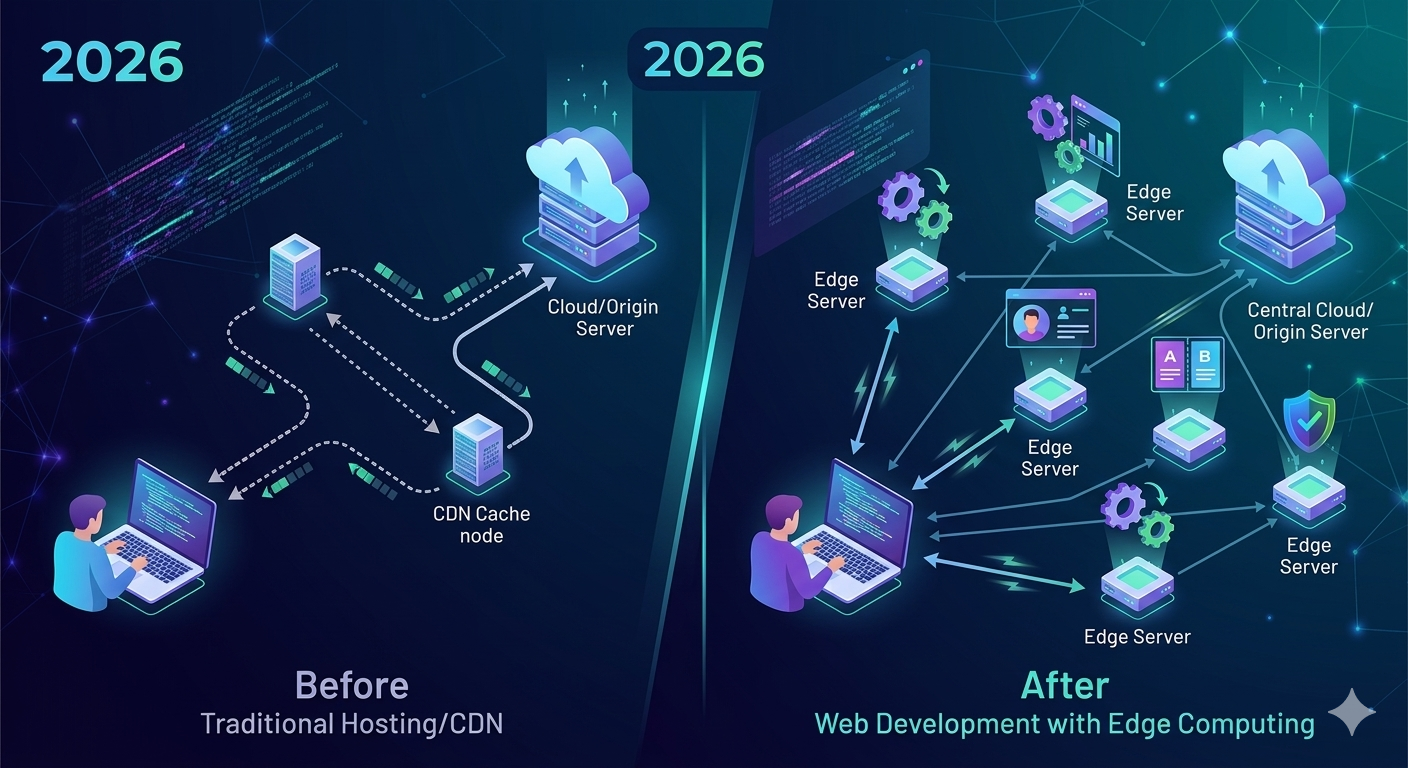
In traditional web architecture, your application runs on servers in one or a few data center locations. When a user in Tokyo requests your website hosted in London, the request travels across the globe, gets processed, and the response travels back. Every kilometre adds latency. Edge computing in web development changes that model by running your application code at hundreds of server locations distributed worldwide — right at the edge of the network, close to where your users actually are.
Think of it this way: traditional cloud hosting is like having one excellent restaurant in your city. Edge computing is like franchising that restaurant so there is one within five minutes of every customer on Earth. The food is the same. The wait is dramatically shorter.
In practical terms, edge computing means platforms like Cloudflare Workers, Vercel Edge Functions, and AWS Lambda@Edge execute your JavaScript, personalisation logic, authentication checks, and API responses at servers typically within 20–50 milliseconds of any user on the planet — compared to 100–400ms from a central data center.
Traditional hosting vs CDN vs edge computing web development — latency comparison for a visitor in Tokyo
Why Website Speed Matters More Than Ever in 2026
Website speed stopped being a “nice to have” years ago. In 2026, it is simultaneously a Google ranking factor, a revenue driver, and a user expectation that has no tolerance for failure.
📊
Core Web Vitals as a Ranking Signal
Google’s Core Web Vitals — Largest Contentful Paint, Interaction to Next Paint, and Cumulative Layout Shift — are confirmed ranking factors in 2026. Sites that fail these thresholds are algorithmically disadvantaged versus competitors that pass them. Edge computing in web development directly improves LCP and TTFB, the two metrics most sensitive to server location.
💰
Every 100ms Costs Revenue
Amazon calculated that every 100ms of added latency costs 1% in sales. Shopify has documented that stores with sub-1s load times convert at nearly double the rate of stores loading in 3+ seconds. Speed is not a technical metric — it is a revenue metric, and edge computing web development addresses it at the architectural level.
📱
Mobile-First User Base
Over 65% of global web traffic in 2026 comes from mobile devices — many on 4G or 5G connections that have lower bandwidth and higher latency than broadband. Mobile users are the least patient with slow load times and the most likely to abandon. Edge computing reduces latency regardless of connection quality by eliminating geographic distance from the equation.
🌍
Global Audiences Expect Global Speed
A business targeting customers in Southeast Asia, the Middle East, or Latin America from a European server is structurally giving those customers a slower experience. Edge computing in web development ensures that your Tokyo visitor and your London visitor experience the same near-instant load time — eliminating geographic disadvantage entirely.
Edge Computing vs Traditional Cloud Hosting
Traditional cloud hosting — whether on AWS EC2, Google Cloud VMs, or Azure compute — centralizes your application at one or a few geographic regions. Here is how that compares to edge computing across every dimension that matters for web performance.
Factor
Traditional Cloud Hosting
Edge Computing Web Development
Latency
100–400ms TTFB globally
5–25ms TTFB from any location
Processing Location
One or few data centers
200+ PoPs globally, closest to user
Scalability
Scales with provisioning, takes time
Instant auto-scaling at every edge node
Cold Start Time
Seconds to minutes for serverless
<1ms for edge functions (V8 isolates)
Dynamic Content
Full — all logic at server
Full — logic runs at edge
Cost at Scale
Compute + bandwidth charges add up
Pay per request, extremely efficient
Setup Complexity
Straightforward — familiar model
Requires understanding edge constraints
Core Web Vitals Impact
Limited — TTFB often fails for distant users
Strong — TTFB consistently excellent
Edge Computing vs CDN: Understanding the Difference
This is the question we hear most often from developers making the transition. CDN and edge computing are related — but they solve fundamentally different problems, and understanding the distinction is essential for choosing the right architecture.
Capability
Traditional CDN
Edge Computing
What it serves
Cached static files (HTML, CSS, JS, images)
Static files + dynamic logic + API responses
Can it run code?
No — cache and serve only
Yes — full JavaScript/WASM execution
Personalisation
No — same cache for all users
Yes — user-specific responses at edge
A/B Testing
Requires origin round-trip
Runs entirely at edge, zero origin latency
Authentication
Must pass to origin server
JWT validation runs at edge
Geo-Routing
Basic — redirect to regional servers
Full — serve localised content at edge
Cache Miss Behaviour
Falls back to slow origin server
Generates response at edge, no origin needed
Best Use Case
Static marketing sites, image delivery
Dynamic apps, SaaS, e-commerce, APIs
💡 Practical rule: Use a CDN when your content is primarily static and identical for all users. Use edge computing in web development when your site serves dynamic, personalised, or API-driven content — which describes the vast majority of business websites in 2026. The best architectures use both: CDN for assets, edge computing for application logic.
How Edge Computing Makes Websites Faster in Practice
Understanding the mechanisms behind edge speed gains helps you identify which parts of your application to move to the edge first.
1
Data Processing Happens Near the User
The most fundamental gain: when your edge function runs in a Frankfurt data center for a Frankfurt visitor instead of routing to a Singapore server, the round trip shrinks from ~200ms to ~8ms. Per Google Developers, TTFB under 200ms is considered good — edge computing makes this achievable from anywhere in the world.
2
Reduced Origin Server Load
When edge nodes handle authentication, routing, personalisation, and API responses, your origin server receives only a fraction of the requests it previously handled. This reduces infrastructure costs, eliminates traffic spikes as a cause of slowdowns, and allows your origin to focus on database-heavy operations where it is genuinely needed.
3
Faster API Responses Through Edge Caching
Edge functions can cache API responses intelligently — serving cached data instantly while refreshing in the background using stale-while-revalidate patterns. A product catalog API that previously made a database round-trip on every call now returns cached results from the edge in under 5ms, with background revalidation keeping data fresh.
4
Real-Time Content Optimization at the Edge
Cloudflare’s edge network, for example, can compress responses, resize images, minify HTML/CSS/JS, and apply security headers as responses pass through — without any changes to your origin application. These real-time transformations at the edge improve performance for every visitor without requiring application code changes.
5
Personalisation Without Latency Penalty
Traditional personalisation required a server round-trip: user requests page → server identifies user → fetches personalised content → responds. With edge computing in web development, the personalisation logic runs at the edge node closest to the user. The personalised response arrives just as fast as a cached static file would — eliminating the classic speed vs. personalisation tradeoff.
Real-World Use Cases of Edge Computing in Web Development
Edge computing delivers measurable gains across virtually every website category. Here are the use cases where the impact is most dramatic.
Real-world performance gains from edge computing in web development across e-commerce, streaming, SaaS, and global sites
E-Commerce
Shopify runs significant portions of its storefront logic on Cloudflare Workers — serving personalised product recommendations, handling cart operations, and executing A/B tests at the edge. The result is a checkout experience that feels identical to a local app regardless of where the customer sits. Edge-deployed e-commerce stores consistently see 25–40% improvements in conversion rate compared to origin-served equivalents with the same product and pricing.
SaaS Dashboards and Applications
Next.js applications deployed on Vercel’s edge network execute authentication, route protection, and initial data fetching at the edge — eliminating the “login flash” and empty state that appears when a page loads before checking whether the user is authenticated. Vercel’s Edge Middleware runs in under 1ms globally, compared to 50–200ms for the same logic on a traditional server.
Global Business Websites
A multinational business serving content in 12 languages previously needed either a monolithic server with high latency for distant users, or separate servers per region requiring complex synchronisation. Edge computing in web development solves this with geo-routing at the edge — detecting the user’s location, selecting the appropriate language and content variant, and serving it from the nearest edge node in milliseconds.
Benefits of Edge Computing for Business Websites
⚡
Dramatically Faster Load Times
Reducing TTFB from 300ms to 20ms is not incremental improvement — it is a categorical upgrade in perceived performance. Visitors experience your website as instant-loading regardless of their location, eliminating the geographic performance gap that disadvantages businesses with global audiences.
📈
Higher Google Rankings via Core Web Vitals
LCP (Largest Contentful Paint) and TTFB are directly improved by edge deployment. Passing Core Web Vitals thresholds — LCP under 2.5s, INP under 200ms, CLS under 0.1 — is significantly easier when your first byte arrives in under 20ms rather than 300ms. Edge computing in web development is the most reliable path to strong Core Web Vitals scores at global scale.
🛡️
Built-In DDoS Protection and Security
Edge platforms like Cloudflare absorb and filter malicious traffic at the network edge before it ever reaches your origin server. DDoS attacks that would overwhelm a traditional server are distributed across hundreds of edge nodes and mitigated automatically — with no configuration required from your team.
💵
Reduced Infrastructure Costs
When edge nodes handle 80–90% of requests, your origin server runs at a fraction of its previous load. This means you can provision smaller, cheaper origin compute and spend less on egress bandwidth — since data travels shorter distances between edge node and user. Many businesses see infrastructure cost reductions of 30–50% after edge adoption.
📉
Lower Bounce Rate and Better Engagement
The correlation between page speed and bounce rate is well-documented. Pages loading in under 1 second have bounce rates roughly 30% lower than pages loading in 3 seconds. Edge computing’s speed improvements translate directly to users staying longer, viewing more pages, and converting at higher rates.
♾️
Infinite Horizontal Scalability
A traffic spike that would crash a single-server setup distributes across hundreds of edge nodes automatically. Your website handles Black Friday traffic the same way it handles a quiet Tuesday — with no pre-provisioning, no auto-scaling delays, and no performance degradation under load. Edge infrastructure scales to meet demand instantly, by design.
Challenges of Implementing Edge Computing
Edge computing in web development is genuinely powerful — but it comes with real constraints that developers need to understand before adopting it.
⚠️
Runtime Constraints at the Edge
Edge functions run in V8 isolates, not Node.js. Many npm packages that work in a standard Node.js environment do not work at the edge — particularly those using native modules, the fs module, or Node-specific APIs. Developers must audit and sometimes replace dependencies when migrating logic to the edge.
🗄️
Database Access Complexity
Traditional databases sit in one location. If your edge function in Tokyo needs to query a PostgreSQL database in Frankfurt, you eliminate the edge speed benefit for that query. Edge-compatible databases (Cloudflare D1, PlanetScale, Neon serverless Postgres) solve this — but migrating to them requires architectural changes.
🔍
Debugging and Observability
Debugging a function running simultaneously across 200 PoPs globally is fundamentally different from debugging a single server. Edge platforms provide logging and tracing tools, but the distributed nature of edge execution makes root cause analysis for intermittent issues more complex than traditional server-side debugging.
💡
Developer Skill Ramp-Up
Edge computing requires developers to think differently about state management, data persistence, and request handling. Teams accustomed to traditional server-side development need time and practice to write edge-compatible code efficiently. The learning curve is real — but for most teams, a few days of hands-on work covers the fundamentals.
Best Tools and Platforms for Edge Computing in Web Development (2026)
Top edge computing platforms for web development in 2026 — Cloudflare Workers, Vercel, AWS Lambda@Edge, Fastly
🌩️
Cloudflare Workers
310+ PoPs · Free Tier · V8 Isolates
The most widely adopted edge computing platform in web development. Cloudflare Workers run JavaScript and WebAssembly at 310+ global locations with sub-millisecond cold starts. The free tier covers 100,000 daily requests — more than enough for most small business deployments. Per the Cloudflare Blog, Workers serve trillions of requests monthly. KV storage, D1 SQLite database, and R2 object storage integrate natively for stateful edge applications.
Best All-RoundFree Tier<1ms Cold Start
▲
Vercel Edge Network
Next.js Native · Edge Middleware · Analytics
The default choice for Next.js teams. Vercel’s Edge Network integrates Edge Functions and Edge Middleware directly into the Next.js development workflow — no extra configuration required. Deploy a Next.js application to Vercel and your middleware automatically runs at the edge globally. As noted on the Vercel Blog, Edge Middleware executes before the cache, enabling authentication, personalisation, and A/B testing without latency penalties.
Next.js NativeEdge MiddlewareBuilt-in Analytics
☁️
AWS Lambda@Edge
CloudFront-Integrated · Enterprise · Node.js
AWS’s edge computing solution integrates with CloudFront to run Lambda functions at AWS’s global edge locations. Lambda@Edge supports Node.js and Python, making it accessible to teams already fluent in those languages. Documented in AWS Documentation, it excels for teams deeply invested in the AWS ecosystem who need edge functions alongside other AWS services. The cold start time is longer than Cloudflare Workers but the Node.js compatibility is broader.
AWS EcosystemNode.js + PythonCloudFront Native
⚡
Fastly Edge Compute
Rust/WASM · Enterprise SLA · Streaming
Fastly’s Compute@Edge platform supports Rust and WebAssembly in addition to JavaScript, making it the preferred choice for teams that need maximum performance from edge compute. Fastly’s real-time log streaming, advanced caching controls, and enterprise SLA make it the standard for large-scale streaming platforms and media companies where latency tolerance is essentially zero. More complex to onboard than Cloudflare or Vercel, but delivers the lowest latency of any commercial edge platform available.
Rust/WASMEnterprise SLALowest Latency
Platform
Best For
Cold Start
Free Tier
Languages
Cloudflare Workers
All-Round Edge
<1ms
100k req/day
JS, TypeScript, WASM
Vercel Edge Network
Next.js Teams
<1ms
Included in Vercel plans
JS, TypeScript
AWS Lambda@Edge
AWS Ecosystem
~50–100ms
1M req/month (free tier)
Node.js, Python
Fastly Edge Compute
Enterprise/Media
<1ms (WASM)
Limited trial
Rust, JS, WASM
Deno Deploy
Deno Developers
<1ms
100k req/day
TypeScript, Deno
Future of Web Performance — Edge Computing and Beyond (2026+)
Edge computing in web development is accelerating, not stabilizing. Here is where the technology is heading over the next two years.
The four-stage evolution of edge computing in web development from 2026 to 2028 — AI, self-healing, instant apps
🧠
AI-Powered Edge Optimization
Machine learning models running at the edge will optimize every request in real time — predicting which resources to preload based on user behavior patterns, dynamically adjusting image compression based on detected network conditions, and personalising content in microseconds without a cloud round-trip. Cloudflare’s AI Gateway already previews this direction.
🔄
Self-Healing Website Infrastructure
When an origin server fails or a database becomes unavailable, future edge systems will automatically serve degraded-but-functional versions of pages from cached edge state, route traffic to healthy regions, and alert engineering teams — all without a single user experiencing a 500 error. Zero-downtime by architectural default, not by engineering heroics during incidents.
⚡
Instant-Loading Full-Stack Applications
The convergence of edge computing, React Server Components, and streaming HTML delivery is making “instant-load” a realistic target for complex web applications — not just static marketing sites. By 2027, full-stack applications with authentication, personalisation, and database-driven content will routinely achieve sub-200ms First Contentful Paint globally through edge rendering on demand.
🤖
Edge-Deployed AI Integration
Small, quantized language models running directly on edge infrastructure will power on-site AI chat, semantic search, and personalisation features without routing user data to external AI providers. This combines the privacy and speed benefits of local AI with the global reach of edge computing — making intelligent, private, instant AI features accessible for any website, not just tech giants.
Final Verdict: Who Should Use Edge Computing in Web Development?
Business Type
Edge Benefit Level
Recommended Starting Point
Priority Feature
Global E-Commerce
Critical
Cloudflare Workers or Vercel Edge
Edge personalisation + cart at edge
SaaS Applications
High
Vercel Edge (Next.js) or Cloudflare
Edge Middleware for auth + routing
Content / Media Sites
High
Cloudflare Workers
Edge caching + image optimization
Local Service Websites
Medium
Cloudflare (free CDN + basic edge)
Core Web Vitals improvement
Small Business Brochure
Low–Medium
Vercel or Cloudflare Pages (free)
Static site edge delivery
Enterprise / High Traffic
Critical
Fastly or AWS Lambda@Edge
Full edge compute + streaming + SLA
✅ Bottom line: If your website serves users in more than one country, handles dynamic personalisation, runs paid advertising that depends on landing page performance, or is targeting Core Web Vitals improvements — edge computing in web development is not optional in 2026, it is the standard. Start with Cloudflare Workers or Vercel Edge. Both have free tiers, excellent documentation, and deliver measurable speed improvements within the first deployment.
Frequently Asked Questions — Edge Computing in Web Development
What is edge computing in web development?
Edge computing in web development means running application logic, data processing, and content delivery at servers physically located close to the end user — at the edge of the network — rather than at a central data center. Platforms like Cloudflare Workers, Vercel Edge Functions, and AWS Lambda@Edge execute JavaScript at 200–310 global locations, reducing latency from hundreds of milliseconds to under 25ms for virtually any user on the planet.
Is edge computing better than CDN for websites?
CDNs cache and serve static files from locations near users — which is excellent for images, CSS, and JavaScript bundles. Edge computing goes further: it runs dynamic application logic, personalisation, A/B testing, authentication, and API calls at the edge too. For primarily static websites, a CDN is sufficient. For dynamic, personalised, or API-driven websites — which describes most business websites in 2026 — edge computing delivers measurably better performance than CDN alone. The best architectures use both together.
How does edge computing improve website speed?
Edge computing in web development improves website speed by processing requests at a server physically close to the visitor instead of routing them to a central data center potentially thousands of miles away. This reduces round-trip latency from 100–400ms to under 25ms, directly improving Time to First Byte — one of the most critical performance metrics for both user experience and Google’s Core Web Vitals rankings. Additionally, edge caching, real-time compression, and image optimization happen automatically as responses pass through the edge network.
Which companies use edge computing for their websites?
Major companies using edge computing in web development include Shopify (Cloudflare Workers for storefront personalisation), Netflix (Fastly for streaming optimization), Vercel customers across thousands of SaaS companies (Vercel Edge Network), Discord (Cloudflare Workers for CDN and routing), and Amazon’s own properties (AWS Lambda@Edge). In 2026, edge deployment is standard practice for any high-traffic, performance-sensitive website regardless of industry.
Is edge computing expensive to implement?
Edge computing is remarkably affordable. Cloudflare Workers offers 100,000 free requests per day and paid plans from $5/month. Vercel Edge Functions are included in standard Vercel plans. AWS Lambda@Edge costs approximately $0.60 per million requests. For most business websites, the infrastructure cost is lower than traditional cloud compute for equivalent traffic — because edge functions are tiny, stateless, and extremely efficient. The real investment is developer time to migrate application logic to edge-compatible code.
Can I use edge computing with my existing website?
Yes — you do not need to rebuild your website to benefit from edge computing. The simplest entry point is deploying to Cloudflare in proxy mode, which adds edge caching, image optimization, and real-time compression to any existing website with no code changes. For deeper integration — edge middleware, edge functions, A/B testing at the edge — some architectural refactoring is required, but you can migrate incrementally, moving one feature at a time rather than rebuilding everything at once.
High-Performance Web Architecture
Ready to Build a Website That Loads Instantly, Everywhere?
YAAM Web Solutions
helps businesses build high-performance websites using modern web architecture, edge computing, and advanced optimization techniques — from Cloudflare Workers integrations to full Next.js edge deployments that pass Core Web Vitals globally.
Whether you want to migrate an existing site to edge infrastructure or build a new high-performance application from scratch, our team brings the technical depth to do it right the first time.
Published by: YAAM Web Solutions TeamReading Time: 12 minutes A PWA portfolio website is revolutionizing how professionals showcase their work online in 2025. Remember when you’d lose a potential client because your portfolio took ages to load on their phone? Those days are over. Today’s freelancers and agencies need websites that load instantly, work offline,…
No-Code & Low-Code Website Development in India: 10 Proven Strategies for 2026 No-Code & Low-Code Website Development in India: 10 Proven Strategies for 2026 | YAAM Web Solutions Digital India 2026 No-Code & Low-Code Website Development in India: 10 Proven Strategies for 2026 By YAAM Web Solutions Team · 14 min read · Updated: February 2026 Home ›…
Published by: Aamer Yousuf | Reading Time: 15 minutes Discover the latest web design trends for 2025. From modern UI/UX, animations, minimal designs to AI-powered layouts—learn what makes websites stand out and how to implement these cutting-edge latest web design trends 2025 in your projects. The latest web design trends 2025 are transforming how businesses…
When building your digital presence, understanding the distinction between a website vs web application becomes crucial for making informed business decisions. While both serve as digital touchpoints for your audience, they differ significantly in functionality, complexity, and purpose. The choice between developing a traditional website or investing in a web application development project can impact…
Author: Yaam Web Solutions Team | Web Design Experts in Kashmir since 2018 Published: 22 Nov 2024 | Reading Time: 12 minutes Kashmir’s breathtaking beauty extends beyond its landscapes to its growing digital ecosystem. Web designing in Kashmir has become essential for businesses looking to showcase their unique offerings while connecting with both local communities…
AI-Powered Smart Websites :The Future of Web Development for Businesses in 2026 AI-Powered Smart Websites: The Future of Web Development for Businesses in 2026 ✦ AI & Web Development · 2026 Outlook AI-Powered Smart Websites: The Future of Web Development for Businesses in 2026 Static websites are dead. Discover how AI-Powered Smart Websites are redefining…