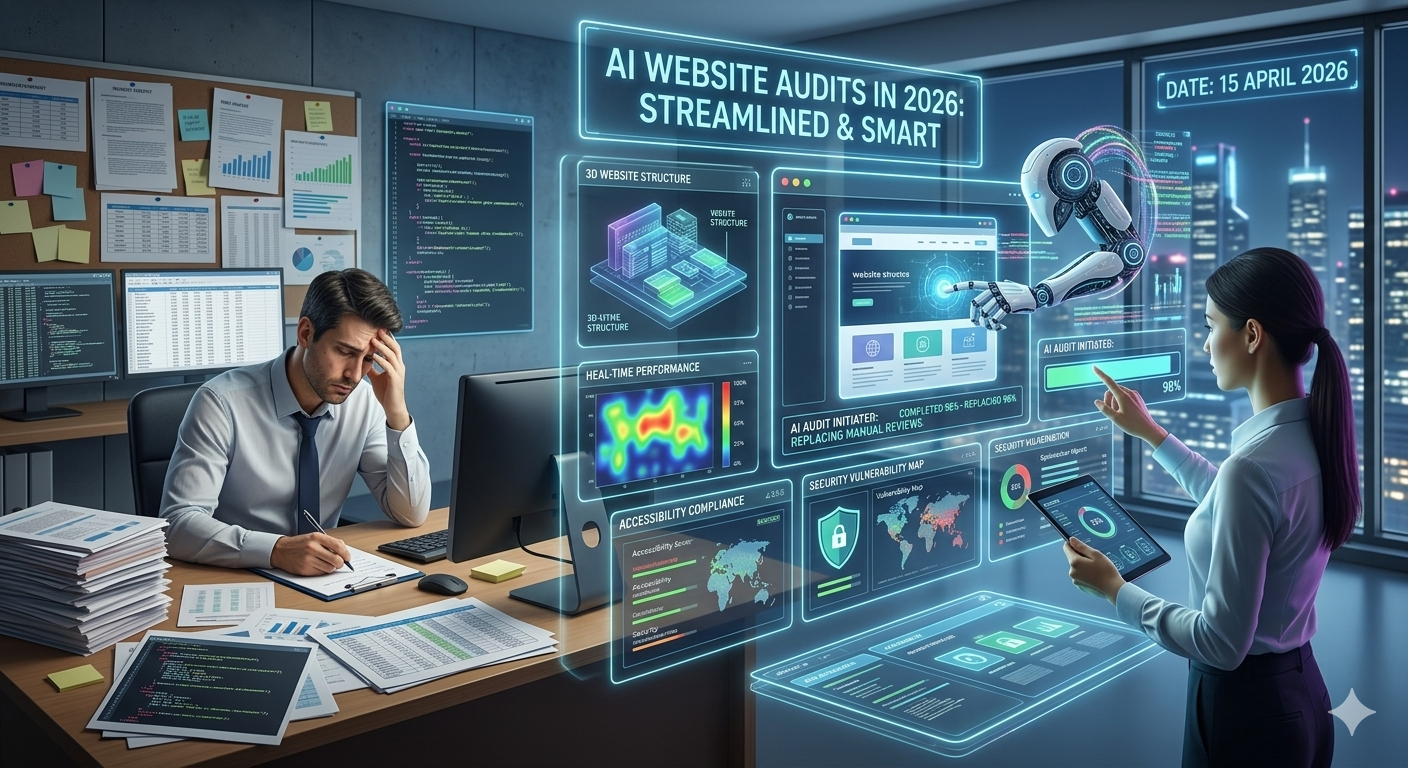
AI Website Audits in 2026: How Smart Tools Are Replacing Manual Reviews
What used to take an agency three days now takes an AI system three minutes. Here is everything businesses, startups, and marketers need to know about AI website audits in 2026.
15 min read
April 18, 2026
YAAM Web Solutions
✍️ Written by YAAM Web Solutions Team|🗓️ Published: April 18, 2026|🔄 Updated: April 18, 2026
AI website audits in 2026 — how smart automated tools replace manual reviews for SEO, performance, and UX
A proper manual website audit used to take a specialist three to five days. Crawling hundreds of pages, checking every meta tag, testing load times across devices, analyzing backlink profiles, identifying UX friction points — all of it done by hand, with spreadsheets. In 2026, AI website audits complete most of that work in under ten minutes. And for many businesses, the AI’s report is more thorough, more consistent, and more actionable than what a junior analyst would produce after a full week of manual review.
This does not mean human expertise is obsolete — far from it. It means the game has changed. At YAAM Web Solutions, we run AI website audits as the first step of every engagement, using the automated scan as a foundation that human strategists then interpret and act on. The combination is what actually moves the needle. This guide explains everything you need to know about how AI website audits work, which tools to use, what they find, and how to get maximum value from them in 2026.
10×faster issue detection with AI website audits vs traditional manual reviews
73%of businesses that run regular AI audits report measurable SEO improvements within 90 days
$0cost for basic AI audits using tools like Google PageSpeed Insights and Search Console
What Are AI Website Audits?
AI website audits are automated website analysis processes that use artificial intelligence, machine learning, and large-scale crawling technology to scan a website comprehensively — checking for technical SEO errors, performance bottlenecks, UX problems, security vulnerabilities, broken links, accessibility issues, and conversion blockers — then delivering a prioritized, actionable report.
Unlike a manual audit, which depends on the knowledge, speed, and attention span of a human analyst, an AI website audit applies a consistent, exhaustive ruleset to every page of your site simultaneously. A crawl of 500 pages that would take a human two days completes in minutes. The AI does not miss a broken canonical tag on page 312 because it got tired at page 200.
Five core areas every AI website audit checks — technical SEO, speed, UX, security, and conversion signals
The defining feature of an AI-powered audit is intelligent prioritization. Older crawl tools returned flat lists of hundreds of issues with no indication of what to fix first. Modern AI website audit platforms rank every issue by its estimated impact on traffic, rankings, and conversions — so your development team knows exactly where to spend the next sprint.
Why Businesses Need AI Website Audits in 2026
Websites are not static. Every content update, plugin change, CMS upgrade, new page added, or third-party script installed creates the potential for new issues. A business that audited its website six months ago and has made changes since then is operating on outdated intelligence — often without knowing it.
⚡
Faster Issue Detection
AI website audits detect broken links, crawl errors, missing alt text, duplicate content, and page speed regressions the same day they appear — not three months later when rankings drop. Early detection means issues get fixed before they cost you real traffic.
💰
Dramatically Lower Cost
A professional manual website audit from an agency costs £800–£3,000 and takes a week. AI website audit tools deliver comparable technical coverage for £0–£100 per month with results in minutes. For businesses that need monthly monitoring, the economics are not even close.
🎯
Better SEO Insights
AI audit platforms like Semrush and Ahrefs cross-reference your crawl data with search performance metrics, backlink profiles, and keyword rankings simultaneously. The result is not just a list of technical errors — it is a complete picture of what is holding your rankings back.
📡
Continuous Monitoring
The best AI website audit tools run scheduled crawls — daily, weekly, or monthly — and alert you when new issues appear. This continuous monitoring replaces the point-in-time manual audit with an always-on health check that never misses a regression.
✅ Real-world impact: A retail client at YAAM Web Solutions ran their first AI website audit and discovered 47 broken internal links, 12 pages with duplicate title tags, and 3 product pages with no schema markup — all invisible to their previous quarterly manual review. Fixing those issues drove a 31% increase in organic sessions within 60 days.
AI Website Audits vs Manual Reviews: The Full Comparison
Understanding where AI audits outperform human analysts — and where they fall short — is essential for building an effective audit strategy.
Factor
AI Website Audits
Manual Website Reviews
Speed
Minutes for full site crawl
2–5 days for comprehensive review
Technical Accuracy
Exhaustive — checks every page consistently
Depends on analyst skill and attention
Cost
Low to zero for ongoing monitoring
High — £800–£3,000 per engagement
Strategic Interpretation
Limited — AI prioritizes but cannot strategize
Expert judgment, business context, creativity
Design & Brand Assessment
Cannot evaluate subjective design quality
Human eye for layout, aesthetics, trust
Scalability
500 or 50,000 pages — same time, same cost
Linear — more pages equals more time and cost
Continuous Monitoring
Automated scheduled crawls
One-time — no ongoing monitoring included
Complex Custom Issues
May flag incorrectly or miss nuanced causes
Human diagnosis for unusual configurations
What AI Tools Check During a Website Audit
Modern AI website audit tools check far more than basic broken links. Here is a comprehensive view of what a full AI audit covers in 2026.
🏗️
Technical SEO Issues
Missing or duplicate meta titles and descriptions, broken canonical tags, improper redirect chains, hreflang errors, robots.txt conflicts, XML sitemap inconsistencies, crawl depth problems, and orphaned pages not linked from anywhere on the site.
🔗
Broken Links and Redirects
Every internal and external link on every page gets tested. AI audit tools find 404 errors, redirect loops, redirect chains longer than three hops, and links pointing to non-canonical URLs — issues that waste crawl budget and damage user experience simultaneously.
⚡
Core Web Vitals and Page Speed
Using Google PageSpeed Insights data and field data from Chrome UX Report, AI audits identify exactly which elements are causing LCP delays, layout shifts, or interaction delays — and which specific assets to optimize first.
📱
Mobile Responsiveness Failures
Tap targets too small for touch, text that overflows its container on small screens, viewport configuration errors, and content hidden behind popups that fail Google’s mobile-friendliness standards — all flagged and prioritized by severity and traffic impact.
🛒
Conversion Blockers
AI audit tools analyze page structure to identify CTAs below the fold, forms with excessive fields, missing trust signals on key landing pages, checkout friction points, and pages with high bounce rates that signal UX problems — turning performance data into actionable conversion improvements.
🔐
Security Vulnerabilities
SSL certificate validity and expiry, mixed HTTP/HTTPS content on secure pages, missing security headers (HSTS, X-Frame-Options, Content-Security-Policy), outdated plugin signatures, and exposed sensitive files that create both security risk and Google ranking penalties.
Best AI Website Audit Tools in 2026
The market for AI website audit tools has matured significantly. Here are the platforms delivering genuine AI-powered analysis rather than basic crawl reports relabeled as AI.
Top AI website audit tools available in 2026 — from comprehensive platforms to specialized analyzers
📊
Semrush Site Audit
AI-Prioritized · All-in-One
The most comprehensive AI website audit platform available in 2026. Semrush crawls your entire site, scores every issue by impact, and cross-references crawl data with your keyword rankings, backlink health, and competitor positions. The AI audit runs on a schedule and sends alerts when new critical issues appear. Per the Semrush Blog, their AI prioritization model reduces the time to first fix by an average of 62%.
Best All-In-OneScheduled CrawlsAI Priority Score
🔎
Ahrefs Site Audit
Backlinks + Crawl · Deep Analysis
Ahrefs Site Audit is the preferred AI website audit tool for technical SEO professionals focused on crawl efficiency, backlink health, and internal link distribution. Its health score system tracks website quality over time, and the crawl data integrates directly with keyword rank tracking and organic traffic analytics. As noted on the Ahrefs Blog, site audits run on their own crawlers — not cached data — for maximum freshness.
Backlink AnalysisHealth Score TrackingPro Level
🐸
Screaming Frog + AI Workflows
Enterprise Crawling · Custom Rules
Screaming Frog remains the gold standard for raw crawl power — it handles enterprise sites with hundreds of thousands of pages that cloud-based tools struggle with. Paired with AI workflows (using the API connection to Semrush, Moz, or custom GPT analysis), it transforms from a data collector into an intelligent audit system. The free version handles up to 500 URLs, making it accessible for smaller businesses too.
Enterprise ScaleFree Tier AvailableCustom Rules
🌊
Surfer SEO Content Audit
Content Optimization · On-Page AI
While most AI website audit tools focus on technical issues, Surfer SEO focuses on the content layer. Its AI analyzes every page against top-ranking competitors for target keywords, identifies content gaps, measures NLP term density, and gives page-by-page recommendations for improving on-page optimization. Essential for businesses whose technical SEO is solid but whose content performance is weak.
Content FocusNLP AnalysisCompetitor Benchmarks
🚀
Google PageSpeed Insights
Free · Google-Official · Core Web Vitals
The free, definitive AI website audit tool for page performance. Google PageSpeed Insights uses real Chrome user data combined with Lighthouse’s lab analysis to score every page on Core Web Vitals — LCP, FID/INP, and CLS. Since Core Web Vitals are a confirmed Google ranking factor, no AI website audit is complete without PSI scores for all key pages.
FreeGoogle-OfficialField + Lab Data
🤖
ChatGPT-Assisted Audit Analysis
AI Interpretation · Strategy Layer
Using ChatGPT or Claude to interpret and prioritize audit reports from Semrush or Ahrefs has become a standard workflow for agencies in 2026. Paste your crawl export into a GPT prompt asking for prioritized action plans, competitor gap analysis, and implementation checklists — and the AI transforms a raw data dump into a focused strategic roadmap. This layer sits on top of traditional tools, not replacing them.
Strategy LayerPairs with any tool$20/mo
AI Website Audit Tools Comparison Table 2026
Tool
Best For
Ease of Use
Pricing
Key AI Features
Semrush Site Audit
All-in-one SEO
Easy
From $139/mo
AI issue prioritization, scheduled crawls, competitor gap detection
Ahrefs Site Audit
Technical + Backlinks
Easy–Medium
From $129/mo
Health score tracking, crawl intelligence, link graph analysis
Screaming Frog
Enterprise Crawl
Advanced
Free / £149/yr
Custom extraction, API integrations, AI workflow plugins
Surfer SEO
Content Optimization
Easy
From $89/mo
NLP analysis, content score, SERP comparison, gap detection
PageSpeed Insights
Core Web Vitals
Very Easy
Free
Real user data, Lighthouse AI, opportunity diagnostics
ChatGPT (GPT-4o)
Strategy Interpretation
Easy
$20/mo
Natural language audit analysis, action plan generation
How Small Businesses Can Use AI Website Audits to Grow
AI website audits are not just for enterprise websites with large SEO teams. Small businesses with limited budgets and no in-house SEO expertise benefit enormously from even a basic monthly AI audit routine.
1
Run a Free Baseline AI Website Audit First
Start with Google Search Console, Google PageSpeed Insights, and the free tier of Screaming Frog — all available at zero cost. These three tools alone will surface broken links, crawl errors, Core Web Vitals failures, missing meta tags, and indexing problems that may have been silently hurting your rankings for months. Fix everything these free tools flag before investing in paid platforms.
2
Schedule Monthly AI Audits to Catch Regressions
Every content update, plugin install, or new page you add creates potential for new issues. Set a recurring monthly AI website audit using Semrush or Ahrefs — both offer affordable entry-level plans. Review the health score trend over time. A declining health score in any given month tells you that something you did that month broke something — and gives you a narrow window to find and fix it before rankings are affected.
3
Use AI Audit Findings to Improve Local SEO
For local businesses, AI website audits frequently reveal missing or inconsistent NAP data (name, address, phone number), absent LocalBusiness schema markup, pages without location-specific keywords, and Google Business Profile disconnects. Fixing these local SEO gaps — most of which take under an hour each — can drive significant improvements in local pack rankings and direction request volume within 30 days.
4
Prioritize Fixes by Revenue Impact
An AI website audit on a 200-page site may surface 80+ issues. Do not try to fix everything at once — that leads to paralysis. Filter issues to your highest-traffic, highest-converting pages and fix those first. A broken contact form on your “services” page costs you leads every day it remains broken. A missing alt tag on a blog post image from 2019 does not. AI audit platforms with priority scoring handle this automatically — trust the priority ranking and work top-down.
Limitations of AI Website Audits
Claiming that AI website audits are a complete replacement for human expertise would be misleading. There are important areas where the technology consistently falls short.
⚠️
No Business Strategy Context
An AI audit cannot know that your homepage bounce rate is high because your primary audience uses mobile and your hero image does not load on 3G — it can only report the bounce rate and the image size. Strategy requires business context that AI tools do not possess.
🚫
False Positives on Complex Setups
AI audit tools flag issues based on rules. A JavaScript-rendered application may show hundreds of “missing content” errors that are false positives — the content loads client-side after the initial crawl. Experienced developers recognize these; a business owner following the AI’s recommendations blindly may waste hours chasing non-issues.
🎨
Cannot Evaluate Design Quality
AI website audits check technical specifications — font size in pixels, color contrast ratios, tap target dimensions. They cannot tell you that your homepage looks outdated, your hero image does not convey trust, or your CTA button color clashes with your brand palette. These subjective design judgments require a human eye.
🔧
Limited Diagnosis for Custom Issues
Enterprise sites with custom frameworks, legacy CMS configurations, or unusual hosting architectures regularly produce audit results that standard AI tools cannot correctly interpret. A unique server-side redirect configuration may look like a redirect loop to the crawler when it is actually functioning correctly. Human debugging is irreplaceable for these edge cases.
Best Practice: Combine AI Website Audits with Human Expertise
The most effective website audit strategy in 2026 is the hybrid approach — using AI for speed and coverage, and humans for strategy and judgment. This is exactly how we structure audits at YAAM Web Solutions.
🤖
Phase 1: AI Crawl and Detection
Run a comprehensive AI website audit using Semrush or Ahrefs. Let the tool crawl every page, compile the issue list, and apply AI prioritization. This phase takes 10–30 minutes and produces an exhaustive technical snapshot of the site’s current state.
🧠
Phase 2: Human Strategy Review
A human SEO strategist reviews the AI output, removes false positives, adds business context to the prioritization, identifies issues the AI missed (brand consistency, messaging clarity, CTA quality), and creates a development roadmap aligned with actual revenue goals rather than abstract health scores.
🔧
Phase 3: Implementation and Verification
Developers implement fixes in priority order. A follow-up AI website audit runs after implementation to verify each fix resolved correctly and did not introduce new issues — a step that is trivially fast with AI tools and that manual verification would make impractically slow.
📡
Phase 4: Continuous AI Monitoring
Ongoing scheduled AI audits run monthly (or weekly for high-traffic sites) to catch regressions. Human review of the trend data happens quarterly — checking health score trajectory, identifying systemic patterns, and adjusting the fix prioritization as the site evolves.
🏆 The hybrid advantage: Businesses using AI website audits combined with human strategic oversight typically see 2–3× better SEO outcomes than those using either approach alone. AI provides the scale and consistency. Humans provide the context and creativity. Neither works as well in isolation.
Future of AI Website Audits — 2026 and Beyond
The capabilities of AI website audit tools in 2026 are impressive — but they represent the early stage of what this technology will deliver. Here is what is coming within the next two years.
The four-stage evolution of AI website audits from scheduled crawls to real-time autonomous systems by 2028
📡
Real-Time Continuous AI Monitoring
Today’s AI website audit tools run on schedules — daily or weekly crawls. By 2027, leading platforms will shift to event-triggered monitoring: every content publish, deployment, or CMS update instantly triggers a targeted re-audit of affected pages. Issues surface within seconds of being introduced, not days or weeks later when they have already impacted rankings.
🔮
Predictive Issue Detection
Rather than simply detecting existing problems, next-generation AI website audit systems will predict issues before they occur. By analyzing update patterns, server behavior, and historical issue data, these systems will warn — “your site has added 12 redirects this month; at this rate you will have a redirect chain problem within 60 days” — before any ranking impact materializes.
🔧
Autonomous Auto-Fixing
For well-defined, low-risk issues, AI audit systems will begin auto-implementing fixes without human approval. Missing alt text will be generated from image AI analysis. Broken internal links will be redirected to the nearest relevant page. Duplicate title tags will be rewritten automatically. Humans will focus only on strategic and complex decisions.
📈
AI CRO Integrated Into Every Audit
Future AI website audits will move beyond technical SEO into conversion rate optimization recommendations at the page level. Analyzing heatmap data, session recordings, and conversion funnel analytics alongside the crawl, the AI will suggest specific CTA repositioning, copy changes, and layout adjustments — making every audit simultaneously an SEO and a revenue optimization exercise.
Final Verdict: Who Should Use AI Website Audits and How Often
Business Type
Recommended Audit Frequency
Best Starting Tool
Priority Focus
Small Business Website
Monthly
Google PSI + Search Console (free)
Core Web Vitals, crawl errors, local SEO
E-Commerce Store
Weekly automated monitoring
Semrush Site Audit
Product page indexing, speed, schema
Content / Blog Site
Monthly + after every major content push
Ahrefs + Surfer SEO
Crawl health, content gaps, internal links
SaaS / Tech Company
Weekly — continuous monitoring
Semrush + Screaming Frog
JS rendering, app performance, conversion pages
Local Service Business
Monthly
Semrush (entry plan)
Local schema, GBP consistency, mobile UX
Marketing Agency
Monthly per client
Screaming Frog + Semrush
Full technical + content + backlink audit
✅ Universal recommendation: Every website — regardless of size, industry, or budget — should run at minimum a free AI website audit using Google Search Console and PageSpeed Insights every single month. The combined free audit from these two Google tools catches the majority of issues that cost businesses rankings and conversions. Start there, fix everything they surface, then graduate to paid tools as your site complexity grows.
Frequently Asked Questions — AI Website Audits
What are AI website audits?
AI website audits are automated analysis processes that use artificial intelligence and machine learning to scan websites comprehensively — checking for technical SEO issues, broken links, page speed problems, mobile responsiveness failures, security vulnerabilities, and conversion blockers — then delivering a prioritized, actionable report in minutes. They replace what would take a human analyst days to complete manually.
Are AI website audits accurate?
AI website audits are highly accurate for detecting technical issues — broken links, missing meta tags, slow load times, mobile failures, crawl errors, and security vulnerabilities. Their accuracy rate on technical issues exceeds what most human auditors produce, simply because they check every page consistently without fatigue. They are less accurate for subjective assessments like design quality, messaging effectiveness, and complex business context — areas where human judgment is still essential.
Which AI website audit tool is best in 2026?
Semrush Site Audit offers the best all-in-one AI website audit experience for most businesses — combining crawl intelligence, keyword data, backlink analysis, and AI issue prioritization in a single platform. For Core Web Vitals and performance, Google PageSpeed Insights is the definitive free tool. For enterprise-scale crawls, Screaming Frog handles volume that cloud tools struggle with. Start with free tools; upgrade to Semrush when your budget allows.
Can AI replace manual website audits completely?
AI website audits replace the data collection, issue detection, and initial prioritization phases of manual audits — work that previously took days now completes in minutes. However, AI cannot replace human strategic interpretation, business context understanding, creative redesign recommendations, or debugging complex custom site configurations. The best results come from combining AI audit speed and coverage with human expert analysis and strategy — a hybrid approach that outperforms either method alone.
How often should I run an AI website audit?
For most business websites, run a comprehensive AI website audit monthly. E-commerce stores and sites running paid campaigns benefit from weekly automated monitoring — issues that cost you conversions get caught faster. At minimum, run an AI audit before and after every significant website update, plugin upgrade, CMS migration, or redesign. The cost of missing a crawl error for three months is almost always higher than the cost of the audit tool subscription.
Are AI website audits free?
Several powerful AI website audit tools are completely free. Google PageSpeed Insights, Google Search Console, and the Screaming Frog free tier (up to 500 URLs) together provide a solid foundational audit at zero cost. Paid platforms like Semrush and Ahrefs start from around $89–$139 per month and add AI prioritization, historical tracking, competitive analysis, and scheduled monitoring on top of the free tools’ capabilities.
AI Audits + Expert Fixes + Real Growth
Ready for a Website Audit That Actually Gets Fixed?
YAAM Web Solutions
combines AI website audits with expert technical fixes, SEO strategy, and modern web development — so you do not just get a report, you get results. We have used this hybrid approach to help businesses across e-commerce, SaaS, and local services recover rankings, fix conversions, and grow sustainably.
Stop guessing what is wrong with your website. Let’s find out — and fix it together.
AI Website Builders vs Web Developers :What Businesses Should Choose in 2026? AI Website Builders vs Web Developers: What to Choose (2026) 2026 Complete Guide AI Website Builders vs Web Developers: What Businesses Should Choose in 2026? The definitive comparison of AI website builders and professional web developers — covering cost, SEO, performance, scalability, and…
Core Web Vitals Optimization :Complete Website Speed Guide for 2026 Core Web Vitals Optimization: Complete Website Speed Guide (2026) 2026 Complete Guide Core Web Vitals Optimization:Complete Website Speed Guide for 2026 Everything businesses and developers need to know about improving Google rankings through Core Web Vitals — LCP, INP, CLS, tools, fixes, and advanced techniques….
Voice Search Optimization for Websites Complete 2026 SEO Guide Voice Search Optimization for Websites: Complete 2026 SEO Guide Blog / SEO & Optimization / Voice Search 2026 🎙️ Voice Search · SEO · 2026 Voice Search Optimization for WebsitesComplete 2026 SEO Guide Everything businesses need to know about optimizing for voice search — from ranking…
How AI Chatbot for Websites Are Transforming Business in 2026 AI Chatbot for Website: How They Transform Business in 2026 2026 Complete Guide How AI Chatbots Are Transforming Business Websites in 2026 Everything business owners, developers, and startups need to know — from choosing the right AI chatbot to integrating it, training it, and converting more visitors…
Website Redesign Services in India: When and Why Your Business Needs a Modern Upgrade Website Redesign Services in India: When and Why Your Business Needs a Modern Upgrade (2026) | YAAM Web Solutions Website Redesign 2026 Website Redesign Services in India: When and Why Your Business Needs a Modern Upgrade By YAAM Web Solutions Team ·…
How AI-Powered Landing Pages Are Increasing Website Conversions in 2026 AI-Powered Landing Pages: Boost Conversions in 2026 2026 Complete Guide How AI-Powered Landing Pages Are Increasing Website Conversions in 2026 Everything developers, marketers, startups, and business owners need to know — from choosing the right AI builder to optimizing for conversions and outranking competitors. 16 min read…