Zero-Click Search and Website Traffic: How Businesses Can Win in 2026
Google is answering more questions before users ever click. Here is exactly how business owners, marketers, and startups protect their traffic — and grow it — in the zero-click era.
16 min read
April 14, 2026
YAAM Web Solutions
✍️ Written by YAAM Web Solutions Team|🗓️ Published: April 14, 2026|🔄 Updated: April 14, 2026
Zero-click search website traffic — complete 2026 strategy guide by YAAM Web Solutions
You ranked number one on Google. Your content was solid. Traffic was growing steadily. Then something shifted — and not your rankings. Google started answering your visitors’ questions before they ever reached your website. That is the reality of zero-click search and website traffic in 2026: more impressions, fewer visits, and a growing frustration among business owners who cannot figure out why their organic traffic dropped without any algorithmic penalty.
The uncomfortable truth is that zero-click search is not a bug — it is Google’s deliberate strategy. Google’s own documentation acknowledges that featured snippets, AI Overviews, and knowledge panels are designed to give users answers instantly. For users, that is excellent. For businesses that depend on organic traffic, it demands a complete strategic rethink. At YAAM Web Solutions, we have spent the last two years helping businesses navigate this shift — and this guide contains everything that actually works in 2026.
62%of all Google searches in 2026 end without a click to any website
40%drop in click-through rates on informational keywords since AI Overviews launched
3×higher CTR for transactional and commercial-intent keywords vs informational ones
What Is Zero-Click Search?
A zero-click search is exactly what it sounds like: a search query where the user finds what they need directly on the Google results page and never clicks through to any website. Google serves the answer through a featured snippet, an AI Overview, a knowledge panel, a calculator widget, a map result, or a direct answer box — and the user’s question is resolved before a single click happens.
The practical impact on zero-click search website traffic is that even if your page ranks position one for a high-volume keyword, a significant portion of users who would previously have clicked through to your site now consume your content inside the search results page and move on. In 2019, roughly 49% of searches ended this way. By 2026, that figure has crossed 62% according to research tracked by Moz and Ahrefs.
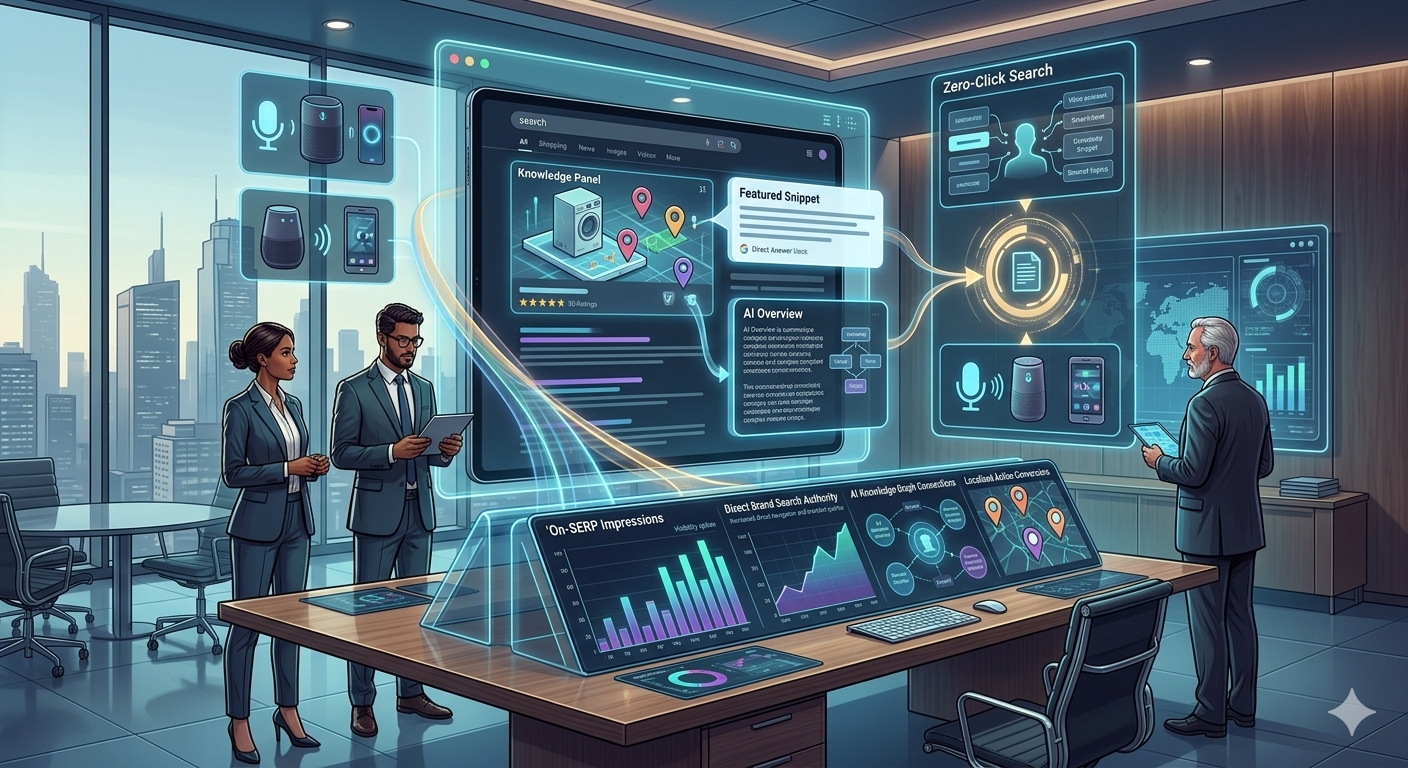
Five ways zero-click search eliminates website traffic before users ever visit your site
Why Zero-Click Search Is Not Going Away
Every major search engine update in 2025 and 2026 has accelerated this trend. Google’s Search Generative Experience evolved into AI Overviews. Bing integrated Copilot deeper into its results. Perplexity AI, ChatGPT Search, and Gemini all answer queries without a website click by design. This is the direction search is moving — and businesses that treat it as a temporary anomaly will keep losing ground.
Why Zero-Click Search Is Increasing in 2026
Several converging forces are accelerating zero-click search website traffic loss simultaneously. Understanding them helps you prioritize where to focus your adaptation strategy.
🤖
Google AI Overviews
AI Overviews now appear for a significant portion of informational queries, sitting above all organic results and providing synthesized answers from multiple sources. According to Search Engine Journal, AI Overview queries show click-through rates up to 70% lower than equivalent queries without the AI block.
⭐
Featured Snippets Expanding
Featured snippets now cover definitions, step-by-step instructions, comparison tables, code blocks, and recipe cards — covering more content types than ever. The more completely a snippet answers a query, the less reason a user has to click through to the source page.
📱
Mobile-First Search Behavior
Mobile users scroll less and click less than desktop users. When Google displays a full answer at the top of a mobile screen, fewer than 20% of users scroll past it. Mobile now represents over 65% of all Google searches globally — and mobile users have the lowest click-through rates of any device category.
🗣️
Voice and AI Assistant Queries
Siri, Alexa, Google Assistant, and ChatGPT’s voice mode all synthesize a single spoken answer from search results. There is no list of ten blue links to choose from — just one answer, and zero clicks to websites. Voice queries grew 25% year-over-year in 2025 and continue accelerating into 2026.
How Zero-Click Search Affects Website Traffic
The zero-click search website traffic impact is not uniform across all websites — but the direction is consistent. Understanding which types of content and keyword categories take the biggest hit helps you reallocate your SEO investment strategically.
📉
Lower CTR on Informational Keywords
Queries like “what is,” “how to,” “definition of,” and “when did” are exactly the ones AI Overviews and featured snippets capture most effectively. Traffic to content targeting these query types has dropped sharply across all verticals in 2026.
📊
Misleading SEO Reporting
Your Google Search Console impressions may be stable or growing while clicks decline. This is because Google counts a featured snippet appearance as an impression but not a click — making it look like your visibility is fine while your traffic quietly erodes.
🏪
Severe Impact on Small Publishers
Blogs, news sites, and educational content producers that built their entire traffic models around informational keywords face the biggest risk. When Google answers “how to change a tire” with an AI Overview, every website that once ranked for that query loses traffic simultaneously.
💰
Ad Revenue and Lead Volume Drops
For businesses that monetize through display advertising or lead capture, fewer visits mean directly fewer dollars. The drop in traffic from zero-click search is not theoretical — it shows up as real revenue reduction for businesses that have not adapted their content strategy.
⚠️ Critical insight: High rankings no longer guarantee zero-click search website traffic. In 2026, a page that ranks position 1 for an informational keyword covered by an AI Overview may receive fewer clicks than a page ranking position 3 for a transactional keyword with no AI Overview. Intent now matters more than rank position.
Zero-Click Search Website Traffic: How Businesses Can Win in 2026
The businesses succeeding despite rising zero-click search website traffic losses are not fighting Google — they are making strategic adjustments that shift their traffic source mix, deepen their content, and improve what happens when visitors do arrive. Here are the five strategies that consistently work.
1
Target High-Intent Transactional Keywords
Google cannot fully answer “hire a web developer in Mumbai” or “buy custom packaging under $500” with a featured snippet — these queries require a vendor, a price, and a decision. Shift your SEO investment toward commercial and transactional keywords where the user’s goal is to take an action, not just learn a fact. These keywords consistently deliver real clicks even as zero-click search website traffic losses mount for informational queries.
2
Build Branded Search Volume Aggressively
When someone searches your company name, no AI Overview appears above your result. Branded searches are zero-click-proof by nature. Build your brand through content marketing, PR mentions, podcast appearances, social media authority, and email newsletters — each of which drives branded search queries that bring users directly to your site with high intent and high conversion rates.
3
Create Content Too Deep to Summarize
A 500-word explainer on “what is SEO” gets replaced by an AI Overview instantly. A 4,000-word guide with original data, proprietary research, detailed case studies, and specific implementation frameworks does not. When your content contains unique insights that Google cannot synthesize from multiple sources, users still need to click through to get the full value. Depth and originality are your best defenses against zero-click displacement.
4
Optimize Your Conversion Rate From Fewer Visitors
If you cannot stop traffic from declining, you can extract more value from every visitor who does arrive. Improving your landing page conversion rate from 2% to 4% doubles your leads from the same traffic. Invest in CRO — better CTAs, faster load times, stronger social proof, clearer value propositions — so that each click you do earn translates to real business outcomes. Check YAAM Web Solutions’ conversion services to see how we approach this for our clients.
5
Diversify Your Traffic Sources
Zero-click search is a Google-specific problem. Email lists, YouTube channels, LinkedIn audiences, and podcast listenership are unaffected by Google’s AI Overviews. Businesses that built diversified traffic sources before 2026 felt far less pain from the zero-click shift. Build yours now — starting with email capture on every page that currently attracts organic traffic.
Best SEO Strategies for the Zero-Click Era
Beyond the traffic recovery tactics above, specific SEO investments consistently outperform in addressing zero-click search website traffic challenges in 2026.
🗺️
Topic Clusters Over Single Posts
Build a hub-and-spoke content architecture where a comprehensive pillar page covers a broad topic and clusters of supporting pages cover related subtopics in depth. This structure signals topical authority to Google, earns more internal link equity, and makes your content harder to summarize in a snippet than isolated blog posts.
❓
FAQ Schema Markup
FAQ schema does the opposite of what you might expect — it makes your content appear as an expandable FAQ section directly in the SERP. Users who click the FAQ dropdown land on your website. Properly implemented FAQ schema on commercial pages increases CTR by 20–30% even in a zero-click search landscape.
🏆
E-E-A-T Signals
Google’s Experience, Expertise, Authoritativeness, and Trustworthiness signals determine which sites Google’s AI cites in AI Overviews. Sites cited in AI Overviews receive brand exposure even without clicks — and earn referral traffic from users who want to verify the source. Building genuine E-E-A-T through author credentials, case studies, and expert citations is both an SEO and a brand strategy.
🎬
Video and Image SEO
Google Images and YouTube are search engines that display far fewer zero-click results than text search. A well-optimized YouTube tutorial or infographic drives clicks that a text article on the same topic would lose to an AI Overview. Diversifying your content format is one of the most overlooked zero-click defenses available.
🔗
Strong Internal Linking
Internal links move users from landing pages to conversion pages — maximizing the value of every visit you earn. In a zero-click world where overall visit volume is lower, the user journey from arrival to conversion must be more deliberate and better structured than ever before.
📊
Original Data and Research
Proprietary surveys, original studies, and unique data sets are content that Google cannot synthesize from publicly available information. When you publish research others cite, you build backlinks and brand authority simultaneously — and your content remains clickworthy long after the zero-click shift captures more generic informational queries.
How to Optimize for Google AI Answers Without Losing Traffic
Appearing in Google’s AI Overviews is a double-edged position in the zero-click search website traffic debate. It signals authority — but it may reduce direct clicks to your site. Here is how to capture the visibility benefit while protecting your traffic.
Five-element framework for optimizing content for AI Overviews while protecting zero-click search website traffic
The key principle for protecting zero-click search website traffic is to structure content so it earns the AI citation but still compels a click. Open each section with a tight two-to-three sentence answer that can appear in an AI Overview or featured snippet — this earns the brand mention and authority signal. Then immediately follow with a deeper layer of specifics, examples, data, or proprietary insights that require clicking through to access. The snippet satisfies the casual reader; the depth converts the serious one.
✅ Practical tip: Ensure every page that targets informational keywords includes at least one clear CTA above the fold — whether a lead magnet offer, a free consultation link, or a relevant tool. The user who arrives from a partial snippet read has already established intent — convert them immediately rather than expecting them to scroll.
Old SEO Strategy vs Zero-Click SEO Strategy: The Full Comparison
Factor
Old SEO Strategy
Zero-Click SEO Strategy (2026)
Expected Result
Keyword Focus
High-volume informational keywords
High-intent commercial & transactional keywords
Higher CTR, more leads
Content Depth
800–1,200 word posts for rankings
3,000–5,000 word pillar content with original data
Snippet-resistant, click-worthy
Success Metric
Organic traffic volume
Conversions, leads, revenue per visit
Real business outcomes
Traffic Sources
Google organic only
SEO + email + YouTube + social + direct
Resilient, diversified
Schema Markup
Basic or none
FAQ, HowTo, Article, BreadcrumbList
Rich results, higher CTR
Content Format
Text articles
Text + video + images + tools + interactive
Multiple search surfaces
Brand Strategy
Optional extra
Core SEO strategy (branded search protection)
Zero-click-proof traffic
CRO Focus
Low priority
High priority — extract max value from every visit
Higher revenue per click
Industries Most Affected by Zero-Click Search Website Traffic Loss
Zero-click search website traffic loss does not hit all industries equally. Certain verticals see their content captured almost entirely by AI Overviews and featured snippets, while others remain largely insulated.
Industry
Zero-Click Impact
Why
Best Defense
Health & Medical
Severe
Symptom queries answered by AI instantly
Clinical depth, E-E-A-T, local doctor SEO
Finance & Banking
Severe
Rates, definitions, calculators in SERPs
Proprietary data, advisory content, trust
Travel & Tourism
High
Destinations, visa info, weather answered directly
Unique experiences, booking CTAs, local SEO
Education
High
Definitions, explanations served in snippets
Courses, certifications, original curriculum
Local Services
Low
Must click to book, call, or get a quote
Google Business Profile, reviews, local content
E-Commerce
Low–Medium
Products require purchase clicks
Product schema, review content, comparison pages
SaaS & B2B
Low
Complex decisions cannot be resolved in a snippet
Deep case studies, ROI calculators, demos
How Small Businesses Can Still Grow Traffic in the Zero-Click Era
Small businesses actually have a structural advantage in the zero-click search website traffic environment that larger publishers do not: local intent. Google cannot fully answer “best plumber in Srinagar” or “web designer near me” — these require a real business, a real location, and a real conversation.
📍
Dominate Local SEO
Local service queries — “near me,” “[city] + service,” and “[industry] in [location]” — still drive clicks because Google cannot resolve them without a business listing. Optimize every page for local keywords, build location-specific landing pages, and ensure your NAP (name, address, phone) data is consistent everywhere.
🗂️
Optimize Your Google Business Profile
Your Google Business Profile is the single highest-ROI local SEO asset available in 2026. Complete every field, respond to every review, post weekly updates, add photos monthly, and enable messaging. A fully optimized GBP generates calls and direction requests — both of which count as conversions without needing a website visit at all.
🎁
Lead Magnets on Every Page
Convert the visitors you do get into email subscribers immediately. A downloadable checklist, a free template, a pricing guide, or a short email course captures the user’s contact details and moves the relationship off Google’s platform entirely — making future communication zero-click-proof by definition.
🎯
Service-Focused Landing Pages
Create dedicated, highly specific landing pages for every service you offer — not just one generic services page. “Website design for restaurants in [city]” is a keyword Google cannot answer with a snippet. A detailed, conversion-optimized landing page for that exact service ranks in organic search and converts the click into a client inquiry.
Future of SEO Beyond Clicks — 2026 and Beyond
Zero-click search website traffic trends have forced the success metric of SEO to shift. Click volume is becoming less meaningful as a primary KPI. Here is what forward-thinking businesses are measuring and building toward instead.
The future of SEO moves beyond zero-click search website traffic toward visibility, brand recall, and multi-platform presence
📊
Search Visibility as the Primary Metric
Forward-thinking SEOs are shifting their reporting from “organic sessions” to “search visibility score” — a metric that accounts for impression share, AI Overview citations, knowledge panel appearances, and rich results, not just clicks. A brand cited in 40% of AI Overviews for its target keywords has enormous awareness even if raw traffic numbers look flat.
🧠
Brand Recall Over Click Volume
When Google’s AI Overview says “according to YAAM Web Solutions,” users who later need your services remember your name. Zero-click exposure builds brand recall that converts through direct searches, word-of-mouth, and branded queries — channels that are immune to the zero-click search effect on informational content.
🌐
Multi-Platform Search Optimization
In 2026, “search” means Google, YouTube, TikTok, Reddit, Pinterest, Perplexity AI, and ChatGPT Search — not just one platform. Businesses that create content optimized for multiple search surfaces reach audiences that never use Google at all. YouTube searches still deliver clicks. Reddit posts still drive traffic. Diversify your search presence beyond Google.
🤖
Search Everywhere Strategy
The next generation of search users asks ChatGPT, uses Perplexity for research, and queries Siri for local recommendations. Optimizing your content to be cited by AI assistants — through structured data, authoritative sourcing, and consistent brand mentions across the web — is the SEO frontier that most businesses have not yet started pursuing.
Final Verdict: Who Needs to Act Right Now?
Zero-click search website traffic challenges affect every business with a web presence — but the urgency varies significantly based on your current traffic model. Here is a clear action guide by business type.
Business Type
Zero-Click Risk
Priority Actions
Content Publishers / Bloggers
Critical
Build email list urgently; shift to deep original content; add lead magnets to every post
Local Service Businesses
Low
Optimize Google Business Profile; build local content; collect reviews consistently
Publish case studies and original research; build thought leadership; invest in video SEO
Healthcare / Finance Sites
Critical
Strengthen E-E-A-T signals; shift to proprietary data; build patient/client portals
Startups
Medium
Build brand from day one; do not depend solely on informational SEO for growth
✅ Universal recommendation: Every business, regardless of industry, should immediately audit their zero-click search website traffic exposure — specifically which percentage of current organic traffic comes from informational keywords likely to be captured by AI Overviews — and begin shifting content investment toward high-intent keywords, branded search building, and email list growth. The businesses that start this transition in 2026 will be insulated by 2027. Those that wait will have a much harder recovery ahead.
Frequently Asked Questions — Zero-Click Search and Website Traffic
What is zero-click search?
Zero-click search occurs when a user’s query is answered directly on the Google results page — through AI Overviews, featured snippets, knowledge panels, calculators, or local packs — without any click to a website. In 2026, over 62% of all Google searches end this way. The trend is growing because Google prioritizes instant answers over directing users to third-party sites.
How does zero-click search affect SEO?
Zero-click search reduces organic click-through rates on informational keywords while leaving high-intent commercial and transactional queries relatively unaffected. Rankings remain meaningful — but the relationship between rank position and actual traffic has weakened significantly for informational content. SEO strategies that once delivered large traffic volumes from top-of-funnel content now require supplementation with intent-focused keywords, email capture, and conversion rate optimization.
Can websites still get traffic from Google in 2026?
Yes — but the strategy has changed. Websites that target transactional and commercial-intent keywords, optimize local search presence, build strong branded search volume, create content that is too deep to summarize in a snippet, and diversify across YouTube, email, and social continue to grow their zero-click search website traffic in 2026. The businesses that struggle are those still relying exclusively on high-volume informational keywords that AI Overviews now capture entirely.
How do businesses win in zero-click search?
The most effective strategies for recovering zero-click search website traffic are: (1) targeting high-intent keywords that require a vendor or decision rather than just an answer; (2) building branded search volume through PR, content, and community; (3) creating deeply researched original content too comprehensive for a snippet; (4) optimizing Google Business Profiles for local intent; and (5) improving conversion rates so every visit earns more revenue than before. The goal shifts from maximizing traffic volume to maximizing business value per visit.
Which keywords still drive real clicks despite zero-click search?
Transactional keywords (“buy,” “hire,” “book,” “download”), local service keywords (“[service] in [city]”), detailed comparison queries (“X vs Y for [specific use case]”), long-tail how-to guides requiring implementation, and branded keywords consistently drive real clicks in 2026. Google cannot fully answer these queries with an AI Overview because they require a specific product, vendor, location, or decision that only the user can make.
Is zero-click search bad for all businesses?
Not equally. Local service businesses, e-commerce stores, SaaS companies, and B2B services face relatively low zero-click risk because their keywords require action rather than just information. The businesses most severely impacted are content publishers, news sites, health information portals, and educational platforms that built their traffic models around informational keywords now captured by AI Overviews and featured snippets.
Future-Ready SEO & Web Strategy
Ready to Protect and Grow Your Traffic in 2026?
YAAM Web Solutions
helps businesses adapt to modern SEO, AI search changes, and traffic recovery with future-ready website strategies. From zero-click-proof content architecture to conversion rate optimization and local SEO — we build digital foundations that grow regardless of algorithm shifts.
Stop watching your traffic erode. Let’s build a strategy that works in the zero-click era — and beyond.
Top Tech Skills in Demand 2025. The technology landscape is evolving faster than ever, and while coding remains important, the most successful professionals in 2025 will be those who master complementary skills that bridge the gap between technology and human needs. These tech skills in demand 2025 are becoming increasingly valuable as companies seek well-rounded…
In today’s fast-paced digital world, website speed can make or break your online success. A slow-loading website doesn’t just frustrate visitors—it hurts your search engine rankings, reduces conversions, and damages your brand reputation. If you’re wondering how to speed up your website, you’ve come to the right place. Studies show that 53% of mobile users…
AI Website Audits in 2026: How Smart Tools Are Replacing Manual Reviews AI Website Audits in 2026: Smart Tools Guide 2026 Complete Guide AI Website Audits in 2026: How Smart Tools Are Replacing Manual Reviews What used to take an agency three days now takes an AI system three minutes. Here is everything businesses, startups, and…
Published by: Aamer Yousuf | Reading Time: 22 minutes When I first helped a local bakery owner set up their online presence, they were frustrated. “Why can’t people find us on Google?” they asked. Despite having a beautiful website and great products, they were invisible in local searches. The problem? They hadn’t optimized their Google…
Core Web Vitals Optimization :Complete Website Speed Guide for 2026 Core Web Vitals Optimization: Complete Website Speed Guide (2026) 2026 Complete Guide Core Web Vitals Optimization:Complete Website Speed Guide for 2026 Everything businesses and developers need to know about improving Google rankings through Core Web Vitals — LCP, INP, CLS, tools, fixes, and advanced techniques….
Best Hosting for Indian Websites :9 Powerful & Reliable Providers (2026) Best Hosting for Indian Websites: Proven 2026 Master Guide 2026 India Hosting Guide Best Hosting for Indian Websites: 9 Powerful & Reliable Providers (2026) The complete guide to choosing the best hosting for your Indian business, blog, or eCommerce store — comparing 9 top…