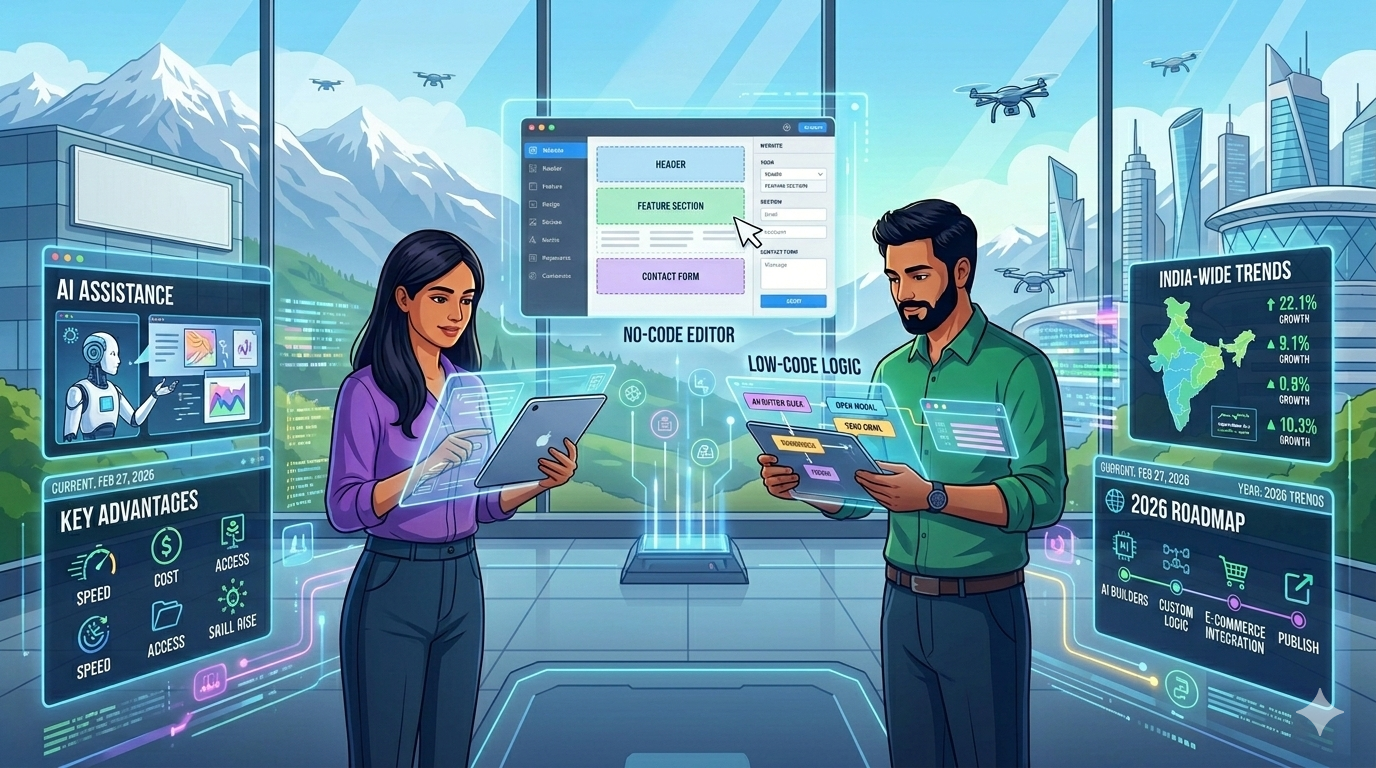
No-Code & Low-Code Website Development in India: 10 Proven Strategies for 2026
No-Code & Low-Code Website Development in India: 10 Proven Strategies for 2026
No-Code & Low-Code Website Development in India: 10 Proven Strategies for 2026

India is living through one of the most exciting digital revolutions the world has ever seen. With over 1.1 lakh DPIIT-recognised startups as of 2025, thousands of entrepreneurs are racing to build their web presence — faster, smarter, and within tight budgets. Enter No-Code & Low-Code Website Development in India: the fastest-growing approach quietly rewriting the rules for how Indian businesses launch online. In 2026, no-code & low-code website development in India is no longer a niche experiment — it is mainstream strategy for thousands of Indian startups and SMEs.
For years, building a professional website meant months of back-and-forth with developers, burning through lakhs in project costs, and dealing with endless revision cycles. Today, the story is entirely different. No-code and low-code platforms let founders, marketers, and SMEs launch polished digital products without writing a single line of code. No-code & low-code website development in India is enabling faster go-to-market than any previous generation of web technology.
Whether you’re a first-time founder in Bengaluru validating a concept, a regional SME owner in Surat ready to go digital, or a marketing head in Mumbai trying to move faster than competitors — this guide gives you everything you need to make the right call.
What is No-Code & Low-Code Website Development?
At its core, no-code & low-code website development in India aims to reduce or eliminate the dependency on traditional programming to build functional websites and applications. Understanding the distinction between these two approaches is the first step for any Indian entrepreneur evaluating their options.
No-Code Development
No-code platforms let users build complete websites using visual drag-and-drop interfaces, pre-designed templates, and logic-based workflows — all without writing a single line of code. Think Webflow, Wix, Squarespace, and Shopify.
Low-Code Development
Low-code platforms occupy a powerful middle ground. They offer the same visual-first experience but with the flexibility to drop in custom code wherever pre-built blocks fall short. Platforms like Bubble, OutSystems, and Mendix fall into this category.
Together, no-code & low-code website development in India is enabling a new generation of digital creators who don’t need a computer science degree to launch world-class digital products.
Why No-Code & Low-Code is Growing Fast in India
The rapid rise of no-code & low-code website development in India is driven by a simple reality: development talent is expensive and in short supply. A mid-level full-stack developer in Bengaluru or Hyderabad commands ₹8–18 lakh annually. For most SMEs and early-stage startups, maintaining a full development team simply isn’t viable.
- Digital India momentum: Government push toward digitisation has created demand at every business level.
- Time-to-market pressure: Launching in weeks instead of months is a genuine strategic advantage.
- Investor expectations: Early-stage investors now expect working MVPs before seed funding conversations.
- Engineering talent gap: Despite producing 1.5 million engineering graduates annually, skilled developers remain scarce and expensive.
- Platform maturity: No-code tools now support production-grade websites handling real traffic and real transactions.

No-Code vs Low-Code vs Traditional Development
| Factor | No-Code | Low-Code | Traditional Dev |
|---|---|---|---|
| Cost | Low | Medium | High |
| Time to Launch | Very Fast | Fast | Slow |
| Customization | Limited | Moderate | Unlimited |
| Scalability | Moderate | High | Very High |
| Technical Skill | None | Basic | Advanced |
| Maintenance | Minimal | Low–Medium | High |
| SEO Control | Moderate | Good | Full |
| Best For | MVPs, landing pages | SaaS apps, portals | Enterprise platforms |
“The question isn’t whether no-code is ‘serious’ enough. The question is whether your problem is complex enough to justify traditional development. For most Indian startups, the honest answer is: not yet.”
Cost of No-Code & Low-Code Website Development in India — 2026 Comparison
The cost advantage of no-code & low-code website development in India is dramatic across every project type:
| Project Type | No-Code Estimate | Traditional Dev | Savings |
|---|---|---|---|
| Landing Page / Portfolio | ₹0 – ₹3,000/mo | ₹25,000 – ₹60,000 | 70–100% |
| Business Website (5–10 pages) | ₹2,000 – ₹8,000/mo | ₹60,000 – ₹1.5L | 60–80% |
| E-Commerce Store | ₹3,000 – ₹15,000/mo | ₹1.5L – ₹5L+ | 50–75% |
| SaaS MVP / Web App | ₹8,000 – ₹25,000/mo | ₹5L – ₹25L+ | 40–65% |
| Enterprise Portal | Not recommended | ₹20L – ₹1Cr+ | — |
Best No-Code & Low-Code Platforms Popular in India

Key Benefits of No-Code & Low-Code Website Development in India for Startups & SMEs
- Launch in days, not months: A standard business website that takes 6–10 weeks in traditional development takes 3–7 days in Webflow.
- Founder-driven product ownership: No more being dependent on a developer’s availability or schedule.
- Lower burn rate: Monthly no-code costs range ₹2,000–₹20,000 versus ₹60,000–₹2,00,000/month for a dedicated developer.
- Built-in integrations: Native connections with Razorpay, PayU, Stripe, popular CRMs, email platforms, and analytics tools.
- Faster iteration: A/B test a landing page headline in 10 minutes — not a 3-day dev ticket.
- Enterprise-grade reliability: Auto-scaled hosting, global CDNs, and 99.9% uptime SLAs included.
Limitations & When You Still Need Developers
- Deep customisation boundaries: Proprietary matching algorithms, complex real-time logic — no-code will resist you.
- Vendor lock-in risk: Heavy investment in a proprietary platform makes migration expensive later.
- Performance ceilings: Some no-code platforms generate suboptimal code that hurts Core Web Vitals.
- Complex database requirements: Multi-relational databases with advanced queries push beyond most no-code tools.
- Regulatory compliance: BFSI, healthcare, or government platforms may require CERT-In compliance and specific data residency.
Security & Scalability Considerations
A common question about no-code & low-code website development in India is data security. The good news: tier-1 platforms take this seriously. Webflow, Shopify, and Bubble offer SSL by default, regular security patches, SOC 2 compliance at higher tiers, and DDoS protection through Cloudflare. For most B2C and B2B businesses handling standard user data, this level of security is entirely adequate.
Scalability follows the same pattern — Shopify handles flash sales for brands doing ₹1Cr+ in a single day without a problem. Webflow’s CDN serves global audiences with sub-200ms response times. The infrastructure is production-grade.
Real Use Cases in the Indian Market
🛒 D2C Retail Brands
Dozens of Indian D2C brands — from natural skincare to sustainable apparel — have embraced no-code & low-code website development in India by building their entire commerce stack on Shopify. Monthly recurring revenue of ₹50L+ is no longer rare for bootstrapped Shopify stores in India.
📚 Ed-Tech Micro-Startups
Solo educators and small coaching institutes are adopting no-code & low-code website development in India to build full course platforms on Teachable, Thinkific, or Webflow paired with Memberstack — without a single developer on the team.
🏢 SME Services Businesses
CA firms, legal consultancies, marketing agencies, and healthcare clinics across Tier-2 India are leveraging no-code & low-code website development in India through WordPress + Elementor or Wix to establish credible digital presence rapidly.
🚀 SaaS Product Startups
Several Y Combinator-backed Indian startups adopted no-code & low-code website development in India by validating their first product on Bubble before rebuilding in React once product-market fit was confirmed.

Future of No-Code & Low-Code in India — 2026 Outlook
- AI-native no-code: Tools like Framer AI and Webflow’s integrated AI features are making website creation as simple as describing what you want.
- Tier-2 and Tier-3 adoption: As internet penetration deepens, demand for affordable, self-serviceable solutions will accelerate.
- Enterprise low-code maturity: Large Indian enterprises in banking, manufacturing, and government are investing in OutSystems and Mendix.
- Workforce upskilling: No-code is entering Indian engineering and MBA curricula, normalising visual-first development.
10 Proven No-Code & Low-Code Website Development Strategies for Indian Businesses
To get maximum value from no-code & low-code website development in India, follow these 10 proven strategies that successful Indian startups and SMEs apply in 2026:
- Start with Webflow for marketing sites: The superior SEO control and design flexibility make it the top no-code choice for Indian SaaS companies and agencies.
- Use Shopify + Indian payment gateways: Razorpay and PayU integrate natively, making Shopify the fastest path to revenue for D2C brands.
- Validate with Bubble before building custom: Build your SaaS MVP on Bubble, confirm product-market fit, then invest in a custom codebase.
- Pair WordPress + Elementor + RankMath: The most powerful low-code SEO stack for Indian service businesses and content-heavy sites.
- Design mobile-first, always: With 70%+ of Indian web traffic on mobile, no-code & low-code website development in India must prioritise mobile UX from day one.
- Use native integrations over custom code: Connect WhatsApp Business, Razorpay, Mailchimp, and Google Analytics through platform-native apps rather than custom APIs.
- Implement schema markup immediately: Every no-code platform supports schema — set up Article, FAQ, and LocalBusiness schema on day one for rich snippet eligibility.
- Build a content hub alongside your product: Webflow CMS and WordPress make content marketing a natural extension of your website without developer involvement.
- Monitor Core Web Vitals weekly: No-code platforms can generate bloated code — monitor Google Search Console CWV reports and optimise images aggressively.
- Plan your exit strategy early: If you anticipate outgrowing a no-code platform, build your data model cleanly from day one to make future migration manageable.
No-Code Website Development in India and SEO — The Full Picture
One of the biggest concerns Indian businesses have about no-code & low-code website development in India is SEO performance. Can a platform-built site compete with custom development in Google India rankings? Can a Webflow or Shopify site actually compete with a custom-built website in Google rankings? The short answer: absolutely — when built correctly.
Webflow SEO Capabilities
When considering no-code & low-code website development in India for SEO, Webflow generates clean, semantic HTML that Google crawlers love. Every page gets full control over meta titles, descriptions, canonical tags, Open Graph data, and structured data. Webflow also publishes to a global CDN by default, meaning Core Web Vitals scores on Webflow sites frequently outperform traditionally developed sites. For any Indian business pursuing no-code website development in India with SEO as a priority, Webflow is the strongest choice in the no-code category.
Shopify SEO for Indian D2C Brands
Shopify’s SEO capabilities have matured significantly. Indian D2C brands using Shopify can customise meta tags at the product, collection, and page level. Apps like Smart SEO and JSON-LD for SEO add schema markup automatically. The main Shopify SEO limitation is URL structure — Shopify forces /products/, /collections/, and /pages/ prefixes that can’t be removed. For most Indian e-commerce businesses, this trade-off is entirely acceptable given the platform’s other advantages.
WordPress + Elementor and RankMath
For no-code & low-code website development in India, the combination of WordPress, Elementor, and RankMath gives Indian SMEs arguably the most powerful SEO stack in the low-code category. RankMath’s real-time SEO analysis, schema generator, and Google Search Console integration make optimising every page straightforward — even without deep technical SEO knowledge. This is why WordPress remains the dominant choice for no-code website development in India among service businesses, consultancies, and content-heavy sites.
Choosing the Right No-Code Development Agency in India
As the adoption of no-code & low-code website development in India grows, so does the understanding of its limits. While these platforms reduce developer dependency, many Indian businesses still benefit from partnering with an experienced agency — especially for the initial setup, SEO architecture, and custom integrations. Here’s what to look for when choosing a no-code website development in India agency:
- Platform certification: Webflow offers official certifications for designers and developers. Shopify has Partner Program credentials. Verify these before engaging an agency.
- Portfolio depth: Ask for live examples in your specific industry — D2C, SaaS, services, or marketplace. Generic portfolios rarely translate into category-specific expertise.
- SEO-first approach: A good no-code agency should discuss site architecture, URL structure, and Core Web Vitals before discussing design. If the first conversation is purely visual, look elsewhere.
- Post-launch support: No-code platforms update frequently. Ensure your agency provides ongoing maintenance, plugin/app management, and security monitoring.
- Pricing transparency: Reputable agencies separate platform subscription costs from development and retainer fees clearly. Avoid agencies that bundle everything opaquely.
At YAAM Web Solutions, our approach to no-code website development in India is strategy-first — we start every engagement with a digital audit, competitive analysis, and platform recommendation before a single design element is discussed. You can explore our full services at yaamwebsolutions.com/services.
Decision Framework: Which Approach is Right for You?
Choosing the right path for no-code & low-code website development in India depends on your business model, budget, technical capability, and growth timeline. Use this framework to make the right call:
Choose No-Code When…
- You need to launch in under 2 weeks
- Budget is under ₹5,000/month
- Building a landing page, portfolio, or brochure site
- Validating an idea, not scaling it yet
- No in-house technical team
- Need a standard e-commerce store (Shopify)
Choose Low-Code When…
- You need custom workflows or user roles
- Budget is ₹10,000–₹40,000/month
- Building a SaaS MVP or web app
- You have a semi-technical team member
- Require third-party API integrations
- Need moderate customisation plus speed
Choose Traditional Dev When…
- Proprietary algorithms are core to your product
- Processing sensitive financial or health data
- Scaling beyond 1M+ active users
- Regulatory compliance is non-negotiable
- Full infrastructure control is required
- Enterprise-grade customisation at every layer
Frequently Asked Questions
What is no-code website development in India?
No-code website development in India refers to building fully functional websites using visual drag-and-drop platforms like Webflow, Wix, and Shopify — without writing any code. It allows Indian startups and SMEs to launch websites in days at a fraction of traditional development costs.
Which is the best no-code platform for Indian startups in 2026?
For Indian startups in 2026, Webflow is best for design-heavy sites and SaaS landing pages, Shopify is the top choice for D2C e-commerce, and Bubble is ideal for building SaaS MVPs and web apps. WordPress with Elementor remains the most widely used option for SME websites across India.
How much does no-code website development cost in India?
No-code website development in India typically costs ₹0–₹3,000/month for a landing page, ₹2,000–₹8,000/month for a business website, and ₹3,000–₹15,000/month for an e-commerce store — saving 60–80% compared to traditional custom development.
Is no-code development good for SEO in India?
Yes, platforms like Webflow offer excellent SEO control with clean HTML output, customisable meta tags, and fast loading speeds. Shopify and WordPress with Elementor also support strong SEO practices suitable for Indian markets and Google India rankings.
Ready to Build Smarter and Launch Faster?
Businesses that invest in no-code & low-code website development in India early will innovate faster, validate ideas quicker, and scale smarter. The only question is whether you start today — or wait while competitors do.
Talk to YAAM Web Solutions →No hard sell. Just an honest, strategy-first conversation about what fits your goals best.


The CBD amassment – [url=https://www.tillmanstranquils.com/products/orange-thc-gummies-240-mg ]thc orange gummies[/url] offers a variety of formats that please different preferences, and each harmonious feels ok executed. The lubricate appears dry-clean and in conformance, the packaging materials bear sturdy, and the fashion is unostentatious until now elegant. The products are quiet to store and fraternize with, thanks to make fast lids and compact sizing. Overall, the maker delivers a outstanding and carefully crafted sample without unrequired extras.
The CBD aggregation – https://www.tillmanstranquils.com/products/mood-gummies offers a variety of formats that suit other preferences, and each harmonious feels well executed. The unguent appears clean and in conformance, the packaging materials discern long-lasting, and the fashion is simple besides elegant. The products are easy to store and treks with, thanks to obvious lids and compact sizing. Total, the brand delivers a impeccable and carefully crafted feel without unrequired extras.
The CBD amassment – [url=https://www.tillmanstranquils.com/products/thc-sex-gummies ]cbd gummies for sex[/url] offers a variety of formats that please exceptional preferences, and each harmonious feels grandly executed. The oil appears unsoiled and consistent, the packaging materials sensible of durable, and the fashion is simple till elegant. The products are quiet to stock and treks with, thanks to make fast lids and aphoristic sizing. Inclusive, the label delivers a impeccable and carefully crafted experience without surplus extras.
References:
Lollybet Casino Bonus https://www.rmnt.ru/go.php?url=https://lollybet.com.de
References:
Lollybet Casino Freispiele welqum.com
References:
%random_anchor_text% http://seafishzone.com/
References:
Stratosphere Casino Login https://amiral-services.com/
References:
Candy96 Casino Australia https://jobexpertsindia.com/
References:
Candy96 mirror link https://mobidesign.us/employer/candy96-bonuses-and-promotions-for-australian-players
References:
Glorion Casino Bewertung smartphone.ua
References:
Candy96 Casino app for android https://toutsurlemali.ml