

AI-Powered Smart Websites :The Future of Web Development for Businesses in 2026
AI-Powered Smart Websites :The Future of Web Development for Businesses in 2026
AI-Powered Smart Websites:
The Future of Web Development
for Businesses in 2026
Static websites are dead. Discover how AI-Powered Smart Websites are redefining user experience, boosting conversions, and giving forward-thinking businesses an unstoppable competitive edge.
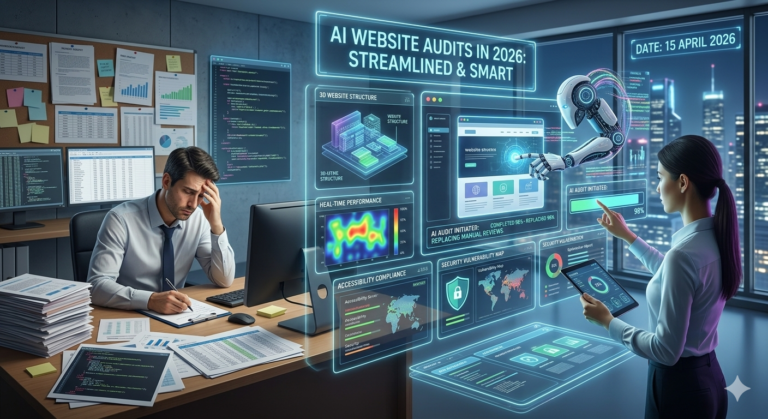
The era of static, one-size-fits-all websites is over. Today’s most successful businesses aren’t just publishing content online — they’re deploying intelligent digital experiences that learn from every visitor, adapt in real time, and optimize themselves continuously. AI-Powered Smart Websites are no longer a futuristic concept reserved for Silicon Valley giants. They are here, they are accessible, and they are the single biggest competitive advantage a business can build online in 2026.
Whether you’re a business owner in Kashmir, an eCommerce founder scaling a product catalog, or a SaaS startup trying to reduce churn — understanding AI-Powered Smart Websites is no longer optional. It’s the difference between a digital presence that grows your business and one that just exists.

What Are AI-Powered Smart Websites?
A traditional website is a static document. Every visitor sees the same headlines, the same product order, the same call-to-action — regardless of who they are, where they came from, or what they need. AI-Powered Smart Websites fundamentally break this model.
At their core, AI-Powered Smart Websites use machine learning algorithms, behavioral data, and real-time processing to deliver a different experience to every visitor. They understand patterns. They predict intent. They test and optimize themselves continuously — without waiting for a developer to push an update. Think of it as the difference between a brochure and a conversation.
A smart website might show a returning visitor their previously viewed products, adjust its homepage headline based on the traffic source, trigger a chatbot when exit-intent is detected, or reorder its navigation based on what device and location the user is on. All of this happens in milliseconds, invisibly, and improves with every interaction.
Why AI Is Transforming Web Development
The reason AI is reshaping web development isn’t philosophical — it’s economic. Businesses that have adopted intelligent, AI-native websites are seeing measurable, repeatable gains in revenue per visitor that static websites simply cannot match. When Amazon implemented personalized recommendations, it attributed 35% of its revenue to that single feature. That’s the commercial reality of intelligent web experiences. Our detailed breakdown of AI in web development and its 12 game-changing tools covers exactly how these systems are being deployed across real projects.
For smaller businesses, the gap is even more pronounced. A local eCommerce store that implements AI-driven product recommendations and a conversational chatbot competes in a completely different league from competitors relying on static category pages. The tools are accessible, the ROI is proven, and the barrier to entry in 2026 is lower than ever. Agencies like YAAM Web Solutions are now building AI-native web experiences for businesses of all sizes — not just enterprise clients.
Core Technologies Behind Smart Websites
Understanding what powers these intelligent platforms helps you ask better questions when briefing a development partner and set realistic expectations for your project.
According to Google’s Machine Learning guides, the most effective AI implementations on the web are those that combine first-party behavioral data with well-structured APIs — rather than attempting to build ML models entirely from scratch. For a curated overview of the tools developers are using right now, see the YAAM guide on AI tools for web developers in 2026.
Real-Time Personalization & Predictive UX

Predictive UX is the practice of anticipating what a user wants before they explicitly ask for it. For AI-Powered Smart Websites, this means analyzing real-time behavioral signals — scroll depth, click patterns, time on page, referral source, device type, and historical session data — to adjust what the user sees next.
Practical Personalization Examples
- Homepage hero swap: A returning visitor who previously browsed trekking tours sees a Himalayan trekking hero image instead of the generic homepage banner
- Dynamic CTAs: A first-time visitor from Instagram sees “Explore Our Work” while a returning visitor from Google sees “Get a Free Audit”
- Content reordering: Blog articles and product categories reorder themselves based on what the current user has shown interest in
- Exit-intent personalization: A departing user who viewed pricing is shown a targeted offer; one who read a blog post is shown a related guide
AI Chatbots & Conversational Interfaces
The chatbot revolution has moved well beyond scripted FAQ bots. Modern AI chatbots — powered by large language models — hold contextual, multi-turn conversations, qualify leads automatically, handle booking requests, answer complex product questions, and seamlessly escalate to a human agent when needed. For businesses that receive high inquiry volumes, an AI chatbot integrated into a smart website can handle 70–80% of inbound queries without any human involvement.
What a Smart Chatbot Does That a Basic One Can’t
- Remembers context across a full conversation session — not just the last message
- Accesses live product availability, pricing, and booking calendars via API
- Qualifies leads by asking the right follow-up questions and tagging them in your CRM
- Switches language automatically based on the user’s browser locale
- Analyzes conversation history to surface FAQs your content team should address
For Kashmir-based tourism and hospitality businesses, a smart chatbot that handles houseboat availability checks, tour pricing queries, and booking confirmations in real time is a revenue-generating asset — not just a customer service feature. This is a core part of what YAAM Web Solutions builds into AI-native web projects. For a practical implementation guide, this deep-dive on mastering ChatGPT for web development and SEO workflows is an excellent starting point.
AI-Driven SEO & Content Optimization
One of the most underappreciated applications of AI in web development is automated SEO optimization. AI-Powered Smart Websites don’t just publish content — they analyze how it performs and suggest or automatically apply improvements based on real search data.
What AI SEO Automation Looks Like in Practice
- Keyword gap detection: AI tools continuously monitor your rankings and flag content gaps before competitors exploit them
- Internal link optimization: Algorithms analyze page authority and user flow to suggest the most valuable internal link placements across your content
- Title and meta A/B testing: AI tests multiple versions of page titles and meta descriptions automatically, promoting the variants that improve click-through rates
- Content freshness signals: Smart systems flag pages with declining organic traffic and recommend specific updates to restore ranking performance
According to web.dev’s performance learning path, pages that combine strong technical performance with AI-driven content relevance signals rank significantly better than pages optimized for either factor alone. This technical SEO checklist for developers in 2026 covers the foundational requirements every AI-powered site needs to meet before advanced optimization kicks in.
AI in eCommerce: Conversion & Revenue Impact
eCommerce is where AI-Powered Smart Websites deliver the most immediate, measurable ROI. The numbers are not marginal — they are transformational. McKinsey research indicates that personalization across eCommerce touchpoints drives 10–15% revenue uplift on average, with best-in-class implementations reaching 25%+. For Kashmir-based businesses specifically, this complete guide on starting an eCommerce store in Kashmir provides the regional context and practical steps to get started.
High-Impact AI Features for eCommerce Websites
- Predictive product recommendations: “You may also like” blocks powered by collaborative filtering — not just rule-based “same category” logic
- Dynamic pricing: Adjust pricing windows based on demand signals, stock levels, and competitive intelligence in real time
- Abandoned cart AI: Predict cart abandonment before it happens and trigger personalized retention offers at the exact right moment
- AI-powered search: Natural language product search that understands “show me warm shawls under ₹2000 for gifting” instead of just keyword matching
- Visual search: Customers upload a photo to find visually similar products — eliminating the friction of text-based search entirely
Technical Architecture of AI Websites
Building intelligent AI websites requires architectural decisions that differ significantly from a standard web build. These choices determine how scalable, maintainable, and effective the AI layer will be over time.
Key Architectural Components
- Headless CMS: Decoupling content from presentation gives the AI layer flexibility to dynamically assemble pages without being constrained by rigid templates (Contentful, Sanity, Strapi)
- Edge computing: Running personalization logic at CDN edge nodes rather than origin servers reduces latency to near-zero — critical for real-time UX adaptation
- Event-driven data pipelines: Every user action fires an event that feeds the AI engine — clicks, scrolls, form interactions, purchases — creating a continuously improving dataset
- API-first integration: AI services (recommendation engine, chatbot, analytics AI) connect via APIs, making them swappable as better models become available
- Feature flags: New AI features are deployed behind flags, enabling gradual rollout and A/B testing without risk to the live experience
Data Privacy & Ethical AI Considerations
The power of these smart, AI-driven platforms comes from data — and data comes with responsibility. Businesses deploying AI-driven personalization must build privacy-first from the ground up, not as an afterthought.
Ethical AI in web design also means avoiding dark patterns — manipulation through misleading urgency timers, artificially inflated “other buyers” counts, or aggressive retargeting that crosses into surveillance. Users in 2026 are more privacy-aware than ever, and the brands that build trust through transparent AI use outperform those that exploit it.
Step-by-Step: How to Build an AI-Powered Website

- Define your AI goals (Phase 1): What specific business outcome do you want AI to improve — conversions, time-on-site, support volume, or SEO performance? Without a clear objective, AI features become expensive experiments with no measurable success criteria.
- Audit your existing data (Phase 1): AI needs data to learn from. Audit your analytics, CRM, and behavioral tracking setup. If you have less than 3 months of clean user data, start collecting before building.
- Select your AI stack (Phase 2): Choose tools that integrate with your existing website architecture. For most businesses, API-based AI services (OpenAI, AWS Personalize, Algolia for smart search) are faster to deploy than custom-built models.
- Build with headless architecture (Phase 3): A headless CMS and API-first frontend gives the AI layer maximum flexibility to assemble and personalize content dynamically.
- Test before you scale (Phase 4): Run controlled A/B tests on each AI feature before full rollout. Personalization that works for 60% of users may hurt results for the other 40% — testing reveals this before it affects revenue.
- Monitor and iterate (Phase 5): Smart AI websites improve with time, but only if someone is watching the data. Set up a monthly performance review cadence to evaluate AI feature impact and adjust configurations.
Common Mistakes Businesses Make Implementing AI
- Adding AI on top of a broken foundation: AI amplifies both strengths and weaknesses. A slow website with poor UX that adds a chatbot becomes a slow website with poor UX and an annoying chatbot. Fix the fundamentals first — as covered in our guide on website migration without losing SEO.
- No data privacy compliance: Deploying behavioral tracking without proper consent mechanisms is a legal liability in India, the EU, and increasingly worldwide.
- Expecting overnight results: Machine learning models need time and volume to improve. Most AI personalization engines take 30–90 days of live traffic before delivering statistically meaningful personalization lift.
- Over-automating customer touchpoints: Replacing every human touchpoint with AI reduces the trust signals that complex purchases and high-value services require. Use AI to handle volume; keep humans visible for decisions that matter.
- Choosing the wrong AI tools for your budget: Enterprise AI platforms are not always necessary. Understanding the true cost and right-sizing your AI stack is essential — this budget guide on website development costs in India helps frame realistic AI investment expectations.
Before vs After AI Integration Comparison

| Metric | Traditional Website | AI-Powered Smart Website |
|---|---|---|
| Personalization | Static — same for all users | Real-time dynamic per visitor |
| Conversion Rate | 1.5% | 3.5%+ |
| Bounce Rate | 65% | 35–40% |
| Average Session Time | 1.2 minutes | 3.8 minutes |
| SEO Performance | Manual updates required | AI-optimized continuously |
| Customer Support Cost | High — fully manual | −60% with AI chatbots |
| Product Discovery | Static categories | Predictive recommendations |
AI Website Optimization Checklist
- Set up behavioral tracking (heatmaps, session recordings, event analytics)
- Deploy an AI personalization engine (Optimizely, Dynamic Yield, or custom)
- Integrate a conversational AI chatbot with CRM connectivity
- Implement predictive product recommendations on all product and category pages
- Enable AI-based A/B testing for headlines, CTAs, and layout variants
- Set up automated content optimization alerts for declining organic pages
- Implement smart search with NLP-based query understanding
- Ensure voice search readiness with conversational keyword structuring
- Balance AI feature load — verify Core Web Vitals still pass after AI scripts added
- Implement GDPR/PDPB-compliant consent management for all data collection
- Configure security and end-to-end data encryption for AI data pipelines
- Establish a monthly AI performance review cadence with defined KPIs
Future of AI in Web Development (2026–2030 Outlook)
The trajectory is clear: by 2030, the distinction between “AI website” and “website” will disappear. Every website will have AI embedded at its core — the question will be how well that AI is implemented, not whether it exists. The businesses building on these intelligent platforms today are establishing the data assets, user trust, and technical foundations that will make this transition seamless.
What’s Coming Next
- Generative UI: Websites that assemble their own page layouts dynamically using generative AI, creating genuinely unique experiences for each visitor session
- Multimodal interfaces: Voice, gesture, and image inputs becoming standard ways to navigate and search websites — not just text and clicks
- Progressive Web Apps (PWAs): Blurring the line between website and native app — offline access, push notifications, home screen installation. Our guide on Progressive Web Apps and why they matter in 2025 covers when and how to adopt them.
- AI-native CMS: Content management systems that auto-generate SEO-optimized content variations, translate in real time, and publish across channels autonomously
- Ambient personalization: Web experiences that remember preferences across sessions, devices, and even across different websites within consented data ecosystems
Design tools are already moving in this direction. The evolution of platforms covered in this Canva Pro 2025 features deep-dive signals how AI-assisted creation is becoming standard across every digital touchpoint — not just code. For the latest insights on AI web development, digital strategy, and performance optimization, follow the YAAM Web Solutions blog.
❓ Frequently Asked Questions
Ready to Build an AI-Powered Website for Your Business?
The businesses adopting AI early don’t just gain a technical advantage — they accumulate data, learn faster, and build compounding competitive moats that are extremely hard to replicate later. YAAM Web Solutions designs and builds AI-native web experiences for businesses ready to lead, not follow.
Start Your AI Web Project →




The CBD store – relaxation gummies offers a assortment of formats that suit singular preferences, and each harmonious feels intimately executed. The unguent appears unsoiled and in conformance, the packaging materials bear long-lasting, and the fashion is uninvolved besides elegant. The products are foolproof to stock and travel with, thanks to sheltered lids and aphoristic sizing. Overall, the kind delivers a polished and carefully crafted test without dispensable extras.
The CBD amassment – https://www.tillmanstranquils.com/products/relief-gummies offers a assortment of formats that make appropriate exceptional preferences, and each one feels well executed. The lubricant appears unsoiled and accordance, the packaging materials feel sturdy, and the connivance is uninvolved till elegant. The products are foolproof to store and fraternize with, thanks to secure lids and thick sizing. Overall, the kind delivers a proficient and carefully crafted test without unnecessary extras.
The scent of this terpene shade – melonade is at bottom sanitary and natural, not too concentrated but motionless clear-cut in the overcome way. It blends smoothly and adds a much better flavor profile without oppressive all things else. Equanimous a small amount makes a argument, which says a a mountain about the quality. The packaging was solid, shipping was fast, and the unimpaired adventure felt reliable. Indeed congested produce and joined I’d providentially uncalled-for again.
References:
Lollybet Casino No Deposit http://www.google.com.pa/url?sa=t&url=https://lollybet.com.de/
References:
Lollybet Casino App Download https://live.warthunder.com/away/?to=https://lollybet.com.de
References:
%random_anchor_text% talenthubsol.com
References:
Vulkan Casino Bonus https://gitea.fcyt.uader.edu.ar/
References:
Candy96 bonus codes giaovienvietnam.vn
References:
Candy96 loyalty program http://guilairo520.gain.tw/
References:
Stargames Casino Bewertung images.google.cd
References:
Candy96 https://talenthubsol.com/